Travel Guide
Hallasan National Park hiking guide: trail choice, summit gate, seasonal gear
This guide is for anyone planning a hike up Hallasan (1,947 m), South Korea's highest mountain and the centerpiece of Jeju Island.
ByMomentBook EditorialPublished
This guide is for anyone planning a hike up Hallasan (1,947 m), South Korea's highest mountain and the centerpiece of Jeju Island. Whether you want to reach Baengnokdam crater at the top or enjoy a half-day forest walk, your main decision is which trail fits your fitness, time, and the season — and whether you leave early enough to pass the summit gate.
Hallasan is a shield volcano and a UNESCO Biosphere Reserve with seven official trails. The two summit trails (Seongpanak 9.6 km and Gwaneumsa 8.7 km) require a reservation and a strict 10:00–12:00 summit gate. The shorter trails (Eorimok 6.8 km, Yeongsil 5.8 km) do not reach the top but offer beautiful mountain and forest scenery. The park is free to enter, but parking fills early and trailside shops do not exist — bring all the water, food, and gear you need.
What to know first
- Park entry is free. No ticket or entrance fee. You only pay for parking (KRW 2,000–5,000) if you drive.
- Summit trails require an online reservation on the Visithalla system (visithalla.jeju.go.kr). Book at least one day ahead during peak season.
- The summit gate closes early. Seongpanak must enter by 10:00 (summit arrival) or 12:00 (last entry at trailhead). Gwaneumsa summit gate closes at 09:00. Late arrivals are turned back.
- Two trails reach the summit: Seongpanak (9.6 km, 4.5 h one way, gradual incline) and Gwaneumsa (8.7 km, 5 h, steep and technical).
- Three shorter trails do not reach the top: Eorimok (6.8 km, 3 h to the shelter), Yeongsil (5.8 km, 2.5 h), and Donnaeko (7 km, 3.5 h).
- No shops or restaurants on any trail. Bring water (at least 1.5 L), snacks, and a packed lunch.
- Winter hiking requires crampons (microspikes). Ice and hard-packed snow cover the upper sections from November to February. Rent them at the trailhead shops.
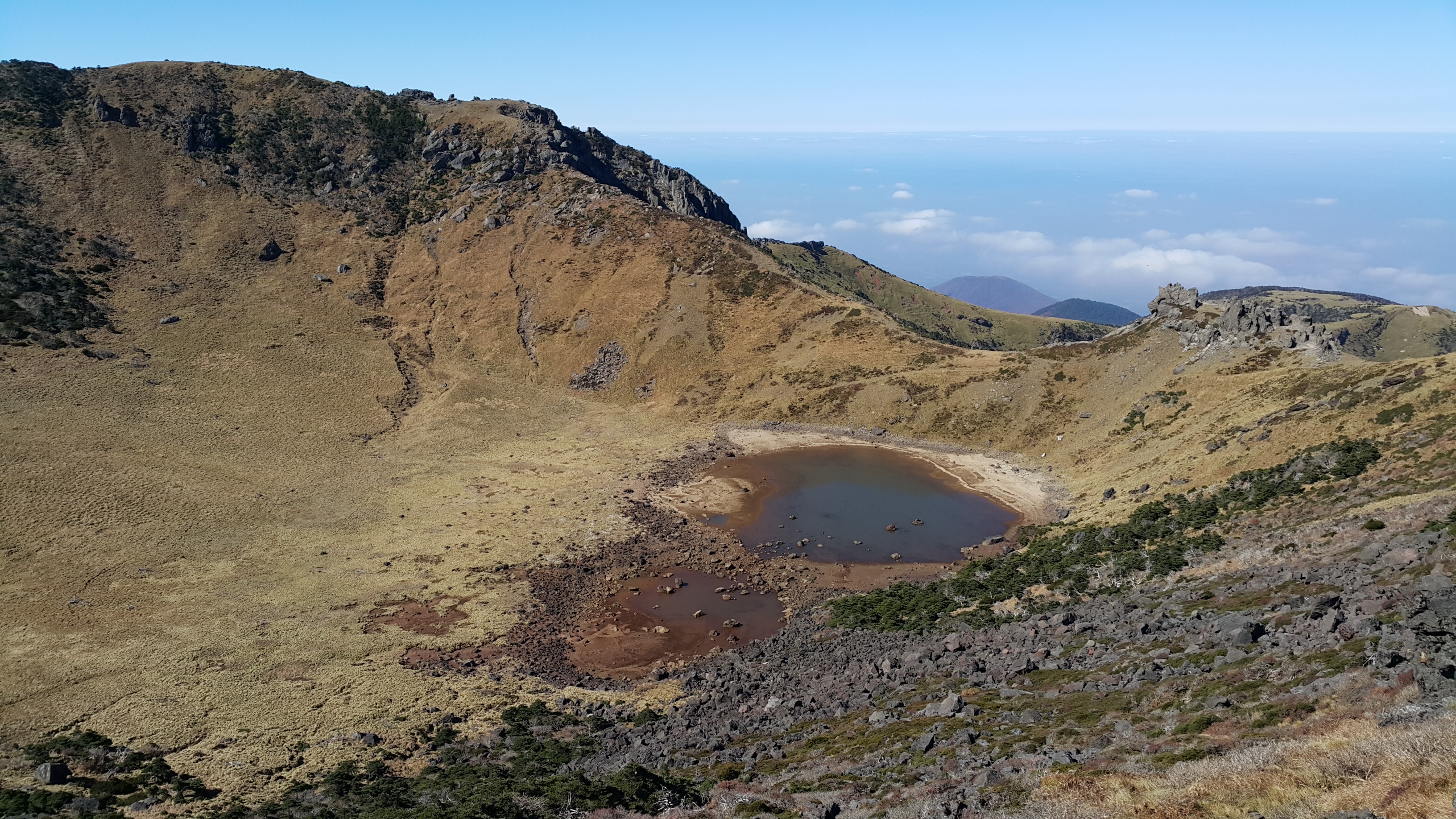
Source: Wikimedia Commons, CC BY-SA
Choose the right trail for your plan
The four most popular trails serve different trip styles:
Seongpanak (9.6 km, 4.5 h one way) — Longest trail but the most gradual slope. Best for hikers who want to reach the summit with moderate effort. Starts at 750 m elevation. Reservation required. You can descend via Gwaneumsa for a one-way 18.3 km loop.
Gwaneumsa (8.7 km, 5 h one way) — Steep, technical trail with a 30-minute stretch of stairs near the top. Starts at 500 m. More challenging than Seongpanak. Reservation required. You can descend via Seongpanak.
Eorimok (6.8 km, 3 h to shelter) — Starts at 970 m. Climbs through mixed forest to Witseoreum shelter at 1,700 m. No summit access. Best for a half-day walk. Connects to the south side trails for descent.
Yeongsil (5.8 km, 2.5 h to shelter) — Shortest trail to Witseoreum shelter. Passes the Ipseokdae rock formation with wide views. No summit access. Good for a morning walk.
Plan the summit timing carefully
Hallasan enforces a strict entrance and summit gate system:
- General trail opening: 05:00 every day, year-round.
- Seongpanak summit gate: Entry to the final summit section closes at 10:00. The trailhead stops new entries at 12:00.
- Gwaneumsa summit gate: Entry to the final summit section closes at 09:00. The trailhead stops new entries at 13:00.
- Eorimok and Yeongsil have no summit gate but trailhead closes at 12:00–13:00 depending on the season.
- If you start after these cutoff times, park staff will block the upper trail regardless of your fitness level.
- The reservation system (visithalla.jeju.go.kr) shows the current day's gate times — check before you go.
Recommended departure (from trailhead):
- Seongpanak: before 08:00 for a relaxed hike, 09:00 at the latest
- Gwaneumsa: before 07:00, no later than 08:00
- Eorimok / Yeongsil: before 10:00
Seasonal rules and essential gear
Summer (June–August): Rain is frequent. Bring a waterproof jacket and quick-dry clothing. UV is strong at altitude; wear sunscreen and a hat. Start early to avoid afternoon thunderstorms. Temperatures at the summit are 8–12°C cooler than at the base.
Autumn (September–November): The clearest season. Light layers and a windproof outer shell are enough on sunny days. Start by 07:00 to reach the summit before 10:00.
Winter (December–February): Ice, snow, and strong winds above 1,500 m. Crampons are mandatory — trailhead shops rent them for KRW 3,000–5,000. Bring a headlamp (sun sets before 18:00), insulated boots, gloves, a warm hat, and thermal layers. Gwaneumsa and upper Seongpanak sections are often closed after heavy snow. Check the KNPS trail status the morning of your hike.
Spring (March–May): Windy and dusty. The early spring bloom (April–May) along the lower trails is beautiful. Bring a windbreaker and sun protection. Summit gate times return to the summer schedule after April 1.
Getting to the trailheads
Trailheads are spread around Jeju Island. Public bus is the most reliable option:
| Trailhead | Bus from Jeju City | Travel time | Bus no. | |-----------|-------------------|-------------|--------| | Seongpanak | Jeju Intercity Bus Terminal | 40 min | 181 (express) or 281 | | Gwaneumsa | Jeju National University | 15 min (after 281) | 281 → 475 (transfer) | | Eorimok | Jeju Intercity Bus Terminal | 35 min | 240 | | Yeongsil | Jeju Intercity Bus Terminal | 35 min | 240 |
- Taxi from Jeju City to any trailhead: KRW 15,000–25,000 (30–40 min).
- Rental car: parking lots fill by 07:00 on weekends and holidays. Use the overflow lots or take the bus.
- Jeju International Airport to Jeju City bus terminal: 10 min by taxi or bus no. 100, 200.
Common mistakes
- Starting too late. The summit gate is strictly enforced. A 09:00 start on Seongpanak gives you only one hour of margin.
- Carrying too little water. No trailside shops exist. 1.5 L is the minimum; 2 L on summer days.
- Wearing sneakers or sandals. Trail sections have loose scree, exposed roots, and — in winter — sheet ice. Hiking boots or trail runners with good grip are essential.
- Underestimating the descent. The 9.6 km down from Seongpanak takes 3–4 hours and strains the knees. Bring hiking poles if you have them.
- Ignoring the weather. KMA issues a mountain weather advisory for Hallasan separately from the Jeju city forecast. Check it before leaving your accommodation.
Who should choose which option
- Summit hikers: Seongpanak for a gradual climb, Gwaneumsa for a more athletic challenge. Book the reservation and start before 08:00.
- Half-day walkers: Eorimok or Yeongsil to the Witseoreum shelter (3 h round trip from Yeongsil, 4 h from Eorimok). No reservation needed.
- Nature photographers: Yeongsil for the Ipseokdae rock views. The Saraoreum pond (a 600 m detour from Seongpanak at 5.8 km) for still water reflections of Hallasan.
- Winter hikers: Seongpanak is safer in icy conditions. Gwaneumsa is often closed. Rent crampons and carry a headlamp.
What to check before you go
- KNPS real-time trail closure: https://www.jeju.go.kr/hallasan/info/info/realtime.htm
- Visithalla reservation system: https://visithalla.jeju.go.kr (for Seongpanak and Gwaneumsa)
- KMA mountain weather (Hallasan): https://www.weather.go.kr/w/theme/mountain-weather.do?groupId=184&mtId=11G001P0
- Jeju bus information: http://bus.jeju.go.kr
- Hallasan National Park phone: 064-713-9950 (Eorimok main office), 064-725-9950 (Seongpanak), 064-756-9950 (Gwaneumsa)
Sources
- Korea National Park Service — Hallasan trail information: https://www.jeju.go.kr/hallasan/index.htm
- Hallasan National Park — Real-time trail status: https://www.jeju.go.kr/hallasan/info/info/realtime.htm
- Hallasan National Park — Safety rules and entrance hours: https://www.jeju.go.kr/hallasan/info/safety/safety.htm
- Visit Jeju — Hallasan hiking: https://www.visitjeju.net
- Jeju Bus Information System: http://bus.jeju.go.kr
- Korea Meteorological Administration — Mountain weather: https://www.weather.go.kr/w/theme/mountain-weather.do