Milford Track: How to Book the One-Way Great Walk and Plan the Boats
This guide is for an international hiker deciding whether the Milford Track fits a New Zealand itinerary and how to book it without breaking the route’s fixed sequence.
ByMomentBook Editorial·Published
This guide is for an international hiker deciding whether the Milford Track fits a New Zealand itinerary and how to book it without breaking the route’s fixed sequence. The decision is not simply “Can I walk 53.5 km?” You need three hut nights, two boat legs, a demanding pass day, and a final boat from Sandfly Point.
The easiest independent plan is the DOC Great Walk season from 1 November 2026 to 30 April 2027, with the last departure on 28 April 2027. Outside that window, the Milford Track becomes a more technical trip with fewer facilities, river and avalanche hazards, and no casual fallback if weather stops the route.
What to know first
The Milford Track is 53.5 km, one way, over 3 nights and 4 days; it is not a loop or a day walk.
In the Great Walk season, book all three huts and every transport leg in advance; camping is not permitted.
An international adult hut place is NZ$152 per night in the 1 November–30 April season; the international child rate is NZ$76.
The route starts with a 1 hour 15 minute boat from Te Anau Downs to Glade Wharf and ends with a roughly 20-minute boat from Sandfly Point to Milford Sound/Piopiotahi.
Day 4 is an 18 km walk that must finish in time for the early-afternoon boat, so do not book a same-day flight or tight onward connection.
Huts provide bunks, mattresses, heating, toilets, basic cooking facilities, lighting, and cold running water—but no showers, cooking utensils, or food.
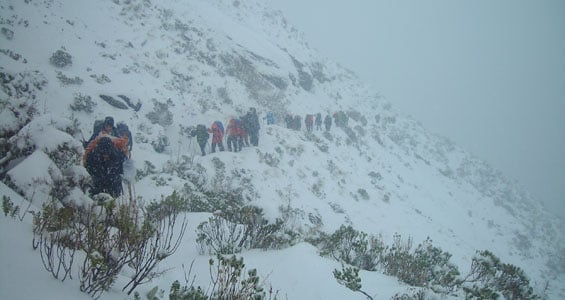
There is no cellphone coverage, and Fiordland weather can bring heavy rain, snow, wind, flooding, or avalanche risk in any season.
The Milford Track crossing Fiordland rainforest and mountain valleys
Source: Department of Conservation Te Papa Atawhai, “Milford Track in November.”
Choose your season before you book
The Great Walk season is the practical choice for most independent visitors. DOC describes it as the period with more facilities and fewer hazards. Huts and transport must be booked, the route is managed as an intermediate tramping track, and each night has a reserved bunk. The international adult hut fee is NZ$152 per person per night, or NZ$76 for an international child aged 0–17, for stays from 1 November through 30 April. Infants aged 0–4 are free. New Zealand rates are separate and require proof of eligibility.
The current DOC page also lists 1 May–31 October as outside the Great Walk season. The hut price drops to NZ$30 per international adult per night and NZ$15 per child, but the lower fee is not a shortcut to an easier trip. Bookings are not required in that period and bunks are first come, first served, while the track has reduced facilities, short daylight, snow and ice, unbridged streams, flooding, and avalanche exposure. DOC says this period is for fit, experienced, well-equipped people with alpine, river-crossing, and navigation skills.
If you are a normal holiday hiker, build the itinerary around the managed season. If you are considering winter or spring shoulder conditions, treat the DOC off-season safety page as a separate skills assessment, not as a budget version of the same walk.
Book all three huts, not just a transport seat
The independent route uses Clinton Hut, Mintaro Hut, and Dumpling Hut in that order. In the Great Walk season, DOC says all three huts must be booked well in advance and camping is not permitted. The booking is for a named person: each walker needs a booking, and DOC may require the given name, family name, age, gender, citizenship or ordinary residence, plus proof of identity. A booking is not transferable, and walkers are required to stay in all three huts on the nights shown in the confirmation.
Start with DOC’s Milford Track booking page, then book the transport chain around the confirmed start date. Without a valid hut booking, you may be charged a penalty or turned away if the hut is full. There are no future-season waitlists, so a full date should trigger a date change or a different Fiordland plan rather than an improvised camp.
Transport is part of the route. From Te Anau, arrange a bus or private transfer to Te Anau Downs, about 30 minutes away. From there, a boat takes about 1 hour 15 minutes to Glade Wharf at the head of Lake Te Anau. At the far end, walk to Sandfly Point and take a boat of about 20 minutes to Milford Sound/Piopiotahi. DOC states that there is no vehicle or private access to the start or end, and transport must be booked in advance. Operators and departure times can change, so confirm them directly after the hut dates are fixed.
Read the four days as one fixed sequence
The route is one-way, not a flexible collection of day hikes. Day 1 is the short orientation day: Glade Wharf to Clinton Hut is 5 km and takes about 1–1.5 hours after the lake boat. Day 2 is the longer valley day, Clinton Hut to Mintaro Hut: 17.5 km and about 6 hours.
Day 3 is the main mountain commitment. Mintaro Hut to Dumpling Hut is 13 km and about 6–7 hours. You climb more than 500 m to Omanui/McKinnon Pass, whose high point is 1,154 m, then descend about 1,000 m. The Sutherland Falls side trip adds about 1.5 hours return, so add it only if the weather, legs, and daylight allow.
Day 4 is 18 km and about 5.5–6 hours from Dumpling Hut to Sandfly Point. The track passes the Boatshed, Mackay Falls, Bell Rock, Lake Ada, and the final smooth section before the endpoint, but the sightseeing does not remove the boat deadline. Leave a safety margin for mud, rain, slower companions, and stops. A flight home on the same day is a poor match for this fixed finish.
Carry a hut-ready pack and all your food
The huts are serviced enough to make the walk possible, not hotel-like. They have bunks and mattresses, heating, toilets, basic cooking facilities, solar lighting, and cold running water. They do not provide showers or cooking utensils, and tap water is not treated, so DOC says to boil it before use. There is no shop on the track and no emergency food supplied in the huts.
For the Great Walk season, plan a 40–60 litre pack, waterproof liner, 3–4 season sleeping bag, first-aid and blister kit, survival kit, map and compass, torch with spare batteries, rubbish bag, booking confirmation, ID, and earplugs. Carry a 1–2 litre bottle, plate, cup, pot or billy, utensils, cleaning kit, waterproof matches or lighter, insect repellent, sunscreen, medication, and all meals and snacks plus emergency food for a delay. Use a rodent-proof food container or bag.
Wear broken-in hiking boots and bring a dry change of clothes, warm sleep layers, waterproof rainwear, warm hat, gloves, and spare socks. A hut bunkroom can still feel cold. If you walk outside the managed season, the DOC list expands to at least two extra days of food, stove and gas, alpine equipment such as ice axe and crampons, avalanche beacon/probe/shovel, and a personal locator beacon.
Treat weather, rivers, and no signal as part of the route
Fiordland receives up to 9,000 mm of rain a year, and DOC warns that cold temperatures, snow, strong winds, and heavy rain can occur at any time. Track closures can change the itinerary. Avalanche risk can extend into December; during the Great Walk season DOC manages that risk to a low level, but walkers may still need a paid flight over a dangerous section. Check the DOC conditions page, NIWA forecast, and the Omanui/McKinnon Pass webcam before departure.
Side streams and rivers deserve a real decision, not a hopeful crossing. Do not cross if a stream is flooded, safe entry and exit points are unclear, or you are unsure. Turn back or wait for the water to drop. There is no cellphone coverage, so leave your plan with a trusted contact and carry a distress beacon; a satellite messenger is worth considering if your transport provider needs to reach you during a delay.
DOC also asks visitors to prevent didymo spread. Didymo is present in Lake Te Anau and Milford Sound but currently not in the Clinton and Arthur rivers. Follow Check, Clean, Dry guidance, do not take water from the specified affected areas, and do not swim in the rivers after swimming in the lakes.
Common mistakes that break the plan
Booking huts but forgetting the Te Anau Downs and Sandfly Point boat legs.
Treating the route as a loop, then discovering that a private car cannot reach either endpoint.
Bringing a tent instead of a confirmed bunk; camping is not permitted on the Milford Track.
Assuming the huts provide showers, cooking gear, treated water, meals, or emergency supplies.
Arriving without the booking confirmation or ID needed for a named reservation.
Scheduling a same-day flight after Day 4, when the early-afternoon boat and weather can shift the finish.
Choosing the lower off-season price without the alpine skills, river-crossing ability, emergency equipment, and extra food DOC requires.
Crossing a flooded stream because the itinerary feels more important than the conditions.
Who should choose this walk
Choose an independent Great Walk season itinerary if you are comfortable carrying four days of food and gear, walking 17.5–18 km on the longer days, and following a reservation and boat timetable. It suits hikers who want a structured route with DOC huts and ranger presence, but it still demands self-reliance.
Consider a guided option if you want professional logistics or interpretive support, but confirm what the guided operator includes and do not assume a commercial package changes DOC’s weather or safety rules. If your group includes children under 10, anyone uncomfortable with steep, slippery, muddy terrain, or a traveler who needs flexible access, choose a different Fiordland experience rather than forcing this route.
What to check before departure
Reopen the official DOC Milford Track page and complete this short check:
Confirm the season, last departure date, live hut availability, named booking details, and international or New Zealand fee category.
Confirm every transport segment: Te Anau accommodation to Te Anau Downs, lake boat to Glade Wharf, and Sandfly Point boat onward to Milford Sound/Piopiotahi.
Check current track alerts, closure notices, NIWA weather, and the Omanui/McKinnon Pass webcam.
Repack for rain, cold, food delays, water treatment, first aid, navigation, and emergency communication.
Tell a trusted person the route and dates, and keep a full day of buffer after the walk before a flight.