Yosemite 2026 without entrance reservations: fees, traffic, shuttles, and road checks
Use this guide if you are planning Yosemite by car, YARTS, or an Amtrak-to-bus connection in 2026 and are unsure whether the old entrance-reservation habit still applies.
ByMomentBook Editorial·Published
Use this guide if you are planning Yosemite by car, YARTS, or an Amtrak-to-bus connection in 2026 and are unsure whether the old entrance-reservation habit still applies. The practical decision is no longer "Which timed entry slot can I get?" It is "Which pass or fee applies to my group, how early do I need to arrive, and can I move around without losing my parking space?"
The National Park Service says Yosemite will not use a timed entrance reservation system for the 2026 season, but that does not make a busy Yosemite Valley day flexible. Parking can still fill early, entrance lines can still run long, some roads and trails change status with weather or work, and the park does not accept cash at entrance stations. Treat the missing reservation as one less document, not as permission to arrive late.
What to know first
Yosemite is not using a season-wide timed entrance reservation system in 2026, according to the National Park Service, but visitors are still told to plan early and check current conditions.
A standard entrance pass costs $20 to $35. A private vehicle pass is $35, covers the vehicle and passengers, and is valid for seven consecutive days.
Non-US residents age 16 and older owe an additional $100 per person unless they enter with an Annual Pass or an America the Beautiful Pass.
Yosemite entrance stations are cashless. Bring a credit card, debit card, or mobile payment method even if you intend to buy at the gate.
From May through September, and on spring and fall weekends or holidays, Yosemite Valley parking may be full after 8 am. If you get a space, leave the car and walk, bike, or use the shuttle.
The free Yosemite Valley shuttles run 7 am to 10 pm. Valleywide buses are listed at 12 to 22 minute intervals, while East Valley buses are listed at 8 to 12 minute intervals.
Check road status the day before and the morning of travel. As checked on June 12, 2026, the NPS current-conditions page had major roads open but also listed roadwork delays.
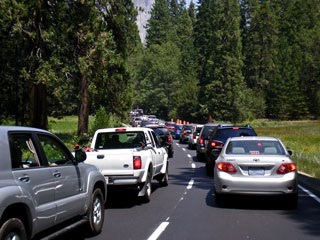
Traffic backed up on a forested Yosemite road near Bridalveil Straight
Source: National Park Service image from Yosemite traffic guidance.
Decide whether you need a reservation, a pass, or an early start
For 2026, the entrance-reservation page changes the first planning question. NPS says the park will no longer use a timed reservation system in 2026 after reviewing 2025 traffic and parking patterns. That means a normal day visitor does not need to chase a peak-hours entrance slot before driving to the gate.
Do not turn that into a relaxed late-morning plan. The same NPS guidance tells 2026 visitors to plan early, consider weekdays, use trip-planning tools, and check seasonal updates. The traffic page is more direct: during the main travel season and busy shoulder-season weekends, entrance delays are common, Yosemite Valley parking may be gone after 8 am, and vehicles can be turned back near El Capitan once the eastern Valley is full.
The practical split is simple. If you already have lodging or a campsite inside Yosemite, plan to park at that lodging or campground and keep the car there. If you are day-tripping by private vehicle, aim for a very early arrival, an early-afternoon reset after the first rush, or an after-5 pm entry if your itinerary is short. If you cannot arrive early, compare YARTS or a guided bus option before assuming you can drive from viewpoint to viewpoint.
Pick the entrance fee before you reach the gate
Yosemite's fee page is not just a price list; it changes who should buy which product. A private vehicle standard pass is $35 and is valid for seven consecutive days for a non-commercial car, pickup, RV, or van with 15 or fewer passenger seats. It covers everyone inside the vehicle, although per-person nonresident fees still apply.
Other common choices are narrower:
Motorcycle: $30, valid for seven days, for up to two private non-commercial motorcycles with up to four total passengers.
Per person: $20, valid for seven days, for visitors age 16 or older entering on foot, bicycle, horse, or non-commercial bus or van. People age 15 and younger do not need this pass.
Yosemite Annual Pass: $70, valid for Yosemite entrance for 12 months from purchase, available to US citizens and residents.
America the Beautiful annual options: useful when your trip includes multiple federal recreation sites; the resident annual pass is listed at $80, while the non-resident annual pass is listed at $250.
International travelers should pause before defaulting to the cheapest standard pass. Yosemite lists an additional $100 per person fee for non-US residents age 16 and older unless they are admitted with an Annual Pass or an America the Beautiful Pass. For a group of several non-US adults, the pass math can change quickly. Also remember that entrance stations do not accept cash, and an America the Beautiful Pass may cover entrance fees but not reservation requirements or reservation fees if those ever apply again.
Choose how to reach Yosemite Valley without moving your car
Once you have entered the park, your most important transportation choice is often to stop driving. NPS warns that driving from site to site increases congestion, and that a second parking space may not exist. In Yosemite Valley, if you find parking at Yosemite Village, Curry Village, near Yosemite Falls, or at your lodge or campground, use that spot as your base.
The free Yosemite Valley shuttle system is the default car-free tool. The valleywide route serves stops throughout Yosemite Valley, including lodges, food service, campgrounds, and trailheads, with buses listed every 12 to 22 minutes from 7 am to 10 pm. The East Valley route is shorter and focuses on Yosemite Village, Curry Village, the Pines campgrounds, and eastern trailheads, with buses listed every 8 to 12 minutes from 7 am to 10 pm.
Shuttles are not a magic queue-skip. On busy days the buses can be full, and NPS says you may need to let multiple buses pass before one has room. Walking and biking are often more reliable for close Valley stops. Public transportation into the park can also reduce the parking problem: YARTS serves Highway 140 all year from the Merced-Mariposa-El Portal corridor, with summer service on Highways 120 east, 120 west, and 41. Amtrak can connect to Yosemite Valley through YARTS service beyond Merced, and Greyhound reaches Merced for a YARTS transfer.
Plan roads, parking, and side trips by area
Yosemite is not one parking lot with one overflow plan. Yosemite Valley is the place most likely to punish a late car arrival. NPS says that if you plan to visit the Valley by car from spring through fall, arrive before 8 am because parking is usually full after that. If all Valley parking is full, vehicles may be diverted back out of the Valley near El Capitan.
Glacier Point needs a separate timing decision. When Glacier Point Road is open, the NPS traffic page advises arriving by 9 am; if the lot is full, delays may reach two hours. Tuolumne Meadows is also limited when Tioga Road is open. Arrive by 9 am, do not use prohibited roadside parking, and consider the YARTS Highway 120 East bus or the Tuolumne Meadows Tour and Hikers' Bus when their seasonal service matches your date.
Mariposa Grove works differently. Most visitors should park at the Mariposa Grove Welcome Plaza near South Entrance and use the free grove shuttle. NPS notes that the welcome plaza has about 300 spaces and can fill by late morning. Current conditions also say that when Mariposa Grove Road is open, it is open only to vehicles displaying a disability placard, while others use the shuttle.
Hetch Hetchy is a poor fallback if you need public transportation. NPS lists no public transportation to Hetch Hetchy Valley, and the current-conditions page says Hetch Hetchy Road is open sunrise to sunset and closes when it is snowing or snow is forecast overnight. Its entrance can also see long delays when parking is full.
Avoid rules that can ruin the day
Several Yosemite rules are easy to miss because they are not entrance reservations. First, do not create roadside or off-road parking. NPS says violators may be towed or cited, and full Valley parking can cause vehicles to be redirected instead of admitted deeper into the Valley.
Second, do not plan to store luggage in the park while you roam. The public-transportation page states that luggage storage is not available in Yosemite at this time. If you are arriving by YARTS or Amtrak plus YARTS, travel with a day pack you can carry or make a lodging plan that solves your bags.
Third, camping and sleeping in a vehicle are allowed only in campsites where you are registered to stay. If the campgrounds are full, you need legal lodging or camping outside the park rather than a quiet parking pullout. On the source-check date, the current-conditions page also listed no first-come, first-served campground availability in Yosemite Valley.
Finally, treat wildlife and water warnings as part of the itinerary. Current conditions said bears were very active and told visitors to store food properly and stay at least 50 yards from bears. The same page warned visitors to use extreme caution around rivers and creeks because rocks can be slippery even when dry. Half Dome is a separate permit decision when the cables are up; do not fold it into a casual Valley sightseeing day.
Who should choose which Yosemite plan
Choose a private-vehicle day if you can arrive before 8 am, keep expectations narrow, and avoid moving the car after parking. This works best for a Valley-focused plan with walking, biking, or shuttle movement after the first stop. It is weaker for travelers who want to sample Yosemite Valley, Glacier Point, Mariposa Grove, and Tuolumne Meadows in one day.
Choose YARTS if your biggest risk is parking, not time. It is strongest on the Highway 140 corridor because that route runs all year, and useful in summer on Highway 41 and Highway 120 corridors when the schedule fits. It is not a fix for heavy luggage, Hetch Hetchy access, or a late-night return without checking the exact timetable.
Choose an America the Beautiful or other annual pass only after matching the rule to your citizenship or residency and the number of federal sites on your trip. A US resident visiting Yosemite once by car will often compare the $35 vehicle pass against a broader annual pass. A non-US resident group should do the extra calculation because the $100 per-person nonresident fee changes the value of annual pass coverage.
Choose a guided bus or tour for specific side trips when parking is the limiting factor. Glacier Point has bus-tour options when the road and tour operate. Mariposa Grove has its own shuttle from the welcome plaza, not a drive-to-the-trees plan for most vehicles.
Final checks before you go
Make these checks close to departure because they are more volatile than the no-reservation headline:
Reopen the NPS entrance-reservation page to confirm that the 2026 no timed reservation policy has not been changed for special conditions.
Reopen the NPS fees page for the latest standard-pass, nonresident-fee, annual-pass, and free-entrance-day details.
Check current road conditions and call 209/372-0200, then press 1 and 1, for the most up-to-date road information.
Check the traffic page before weekends or holidays, and use the text alert option, ynptraffic to 333111, when the park is extremely busy.
If roadwork is listed, add buffer time. On June 12, 2026, NPS listed El Portal Road and Yosemite Valley roadwork with daytime delays up to 15 minutes and nighttime delays up to 30 minutes, plus weekday Big Oak Flat Road delays.
Confirm the exact YARTS, shuttle, tour, or grove-shuttle schedule for your date. Seasonal services may start late, end early, or skip years.
Pack food, water, a payment card, offline maps, and a plan for bags. Do not rely on cash, roadside parking, luggage storage, or sleeping in the car.