Mount Fuji Climbing Guide 2026 — Fees, Trail Choice, and Reservation Rules
If you are planning to climb Mount Fuji this summer, the window of opportunity is narrow, the rules have tightened, and turning up without preparation is no longer an option.
ByMomentBook Editorial·Published
If you are planning to climb Mount Fuji this summer, the window of opportunity is narrow, the rules have tightened, and turning up without preparation is no longer an option. This guide covers the four official trails, the ¥4,000 hiking fee you must pay before you start, the reservation systems for each prefecture, and the gear and timing decisions that determine whether you reach the summit or turn back early.
The biggest constraint on every Mount Fuji climb is the combination of a short 71-day official season, a hard 4,000-person daily cap on the most popular Yoshida Trail, a blanket ban on overnight climbing without a mountain-hut booking, and altitude that hits inexperienced climbers harder than they expect. Almost every mistake on Fuji comes from underestimating one of these four factors.
What to know first
The 2026 official climbing season runs July 1 to September 10 for the Yoshida and Subashiri trails, and July 10 to September 10 for the Fujinomiya and Gotemba trails.
Every climber on every trail must pay a ¥4,000 hiking fee before entering the mountain area. This is a flat rate with no child discount.
The Yoshida Trail (Yamanashi side) caps daily entries at 4,000 climbers. The gate closes once the cap is reached and stays shut from 14:00 to 03:00 for anyone without a mountain-hut booking.
Bullet climbing — ascending through the night without staying at a mountain hut — is prohibited on all four trails.
You must pre-register: Yoshida climbers use the asoview reservation platform; climbers on the three Shizuoka trails use the FUJI NAVI smartphone app, which includes a mandatory e-learning course and safety test.
Mountain huts cost roughly ¥8,000–¥15,000 per person per night. You book directly with each hut by phone or website, not through the reservation system.
Altitude sickness is the number one reason climbers turn back. The summit is 3,776 metres, and the temperature at the top can drop near freezing even in midsummer.
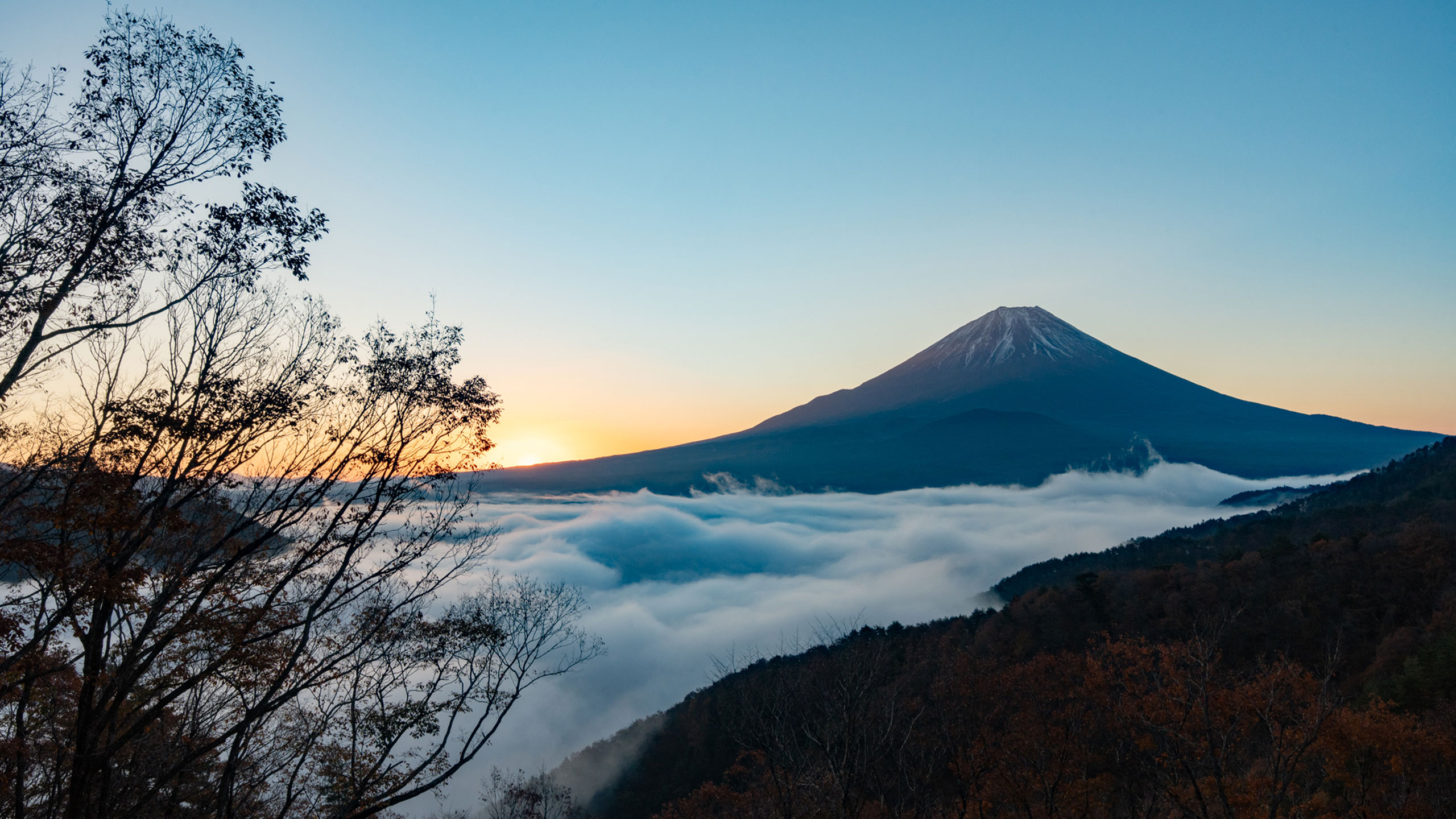
Mount Fuji summit and climbing trail during the summer season
Mount Fuji has four official climbing trails, and picking the wrong one will cost you hours of unnecessary suffering. All trails converge near the summit, but they start at different altitudes and differ sharply in length, terrain, and infrastructure.
The Yoshida Trail (Yamanashi Prefecture) starts at 2,305 metres on the Fuji-Subaru Line 5th Station. It is the most popular route, with the densest concentration of mountain huts, first-aid stations, and the best bus access from Tokyo. The ascent is about 6.8 kilometres and takes roughly six hours. The descent is 7.0 kilometres and takes about three hours. Terrain is a mix of rock and gravel. Choose this trail if you want the most infrastructure and do not mind crowds.
The Fujinomiya Trail (Shizuoka Prefecture) starts at 2,400 metres, the highest trailhead of the four. The ascent is the shortest at 4.3 kilometres and takes roughly five hours, with the same distance and about three hours for descent. It is mostly rocky with fewer huts. Pick this if you want the shortest climb but can handle a steeper, rockier route.
The Subashiri Trail (Shizuoka) starts at 2,000 metres. The ascent is 6.9 kilometres and takes about seven hours; the descent is 6.2 kilometres and takes about four. It begins in a forested section before opening onto volcanic gravel and joins the Yoshida Trail near the 8th station. Choose this if you want a quieter climb with some tree cover on the lower section.
The Gotemba Trail (Shizuoka) starts at just 1,440 metres, the lowest trailhead. The ascent is the longest at 10.5 kilometres and takes about nine hours. The terrain is mostly loose volcanic gravel and the descent — 8.4 kilometres, about four hours — includes a long scree run. This trail has the fewest mountain huts and no first-aid centre. Only choose this if you are fit, experienced, and want solitude.
Pay the hiking fee and register before you go
In 2026 the hiking fee is ¥4,000 per person across all trails. This is a flat mandatory charge — the ¥2,000 base fee plus ¥1,000 optional donation system from 2025 has been consolidated into a single payment. Children pay the same amount; there is no junior discount.
Yoshida Trail (Yamanashi): Register and pay through the asoview reservation platform. You can reserve online with a credit card or PayPay. Same-day on-site registration is possible but pointless if the 4,000-person daily cap has already been reached. Cancellation is free until the day after payment; after that, the full ¥4,000 is non-refundable. Bring proof of payment — a screenshot or the confirmation email — to show at the gate.
Fujinomiya, Gotemba, and Subashiri trails (Shizuoka): Download the Shizuoka Prefecture FUJI NAVI app. Pre-registration for the 2026 season opened on May 8. Before you can pay, the app requires you to complete an e-learning module and pass a short safety test with every question correct. On-site registration is available at the trailhead for climbers without a smartphone, but expect a 30-minute wait.
Once registered, your reservation is valid only for the date and trail you selected. You cannot switch trails on the day without registering and paying again.
Plan your timing: gates, closures, and the bullet-climbing ban
The most common scheduling mistake on Mount Fuji is arriving at the gate during the closed hours. On the Yoshida Trail, the gate is closed from 14:00 to 03:00 for climbers who do not have a mountain-hut booking. If you arrive at the 5th Station at 13:30 without a hut reservation, you will be turned away. On the three Shizuoka trails, entry between 14:00 and 03:00 also requires a confirmed hut booking.
The Yoshida Trail gate also closes at any time of day once the 4,000-climber cap is reached. On weekends and during the mid-August Obon holiday period, the cap can be reached by mid-morning. Reserve your date in advance and start early.
Bullet climbing — starting in the evening, climbing through the night, and reaching the summit at sunrise without sleeping at a hut — is now prohibited on every trail. The rules are enforced at the gates and by patrols on the mountain. If you want to see sunrise from the summit, book a hut at the 7th or 8th station, sleep a few hours, and start the final push around 02:00.
Private vehicles cannot reach most 5th Station trailheads during the season. The Fuji-Subaru Line (Yoshida) is closed to private cars from July 3 18:00 to September 10 18:00. The Mt. Fuji Skyline (Fujinomiya) is restricted from July 10 9:00 to September 10 18:00. The Fuji-azami Line (Subashiri) is restricted from July 1 9:00 to September 10 18:00. Gotemba Trail has no private-vehicle restriction and offers free parking with about 450 spaces.
Book a mountain hut or commit to a single-day push
You can climb Mount Fuji in a single day if you start early and are reasonably fit, but the experience is punishing and you will miss sunrise from the summit. Most climbers book a mountain hut, sleep from roughly 19:00 to 01:00, and start the final ascent in the dark to arrive at the summit before dawn.
Huts cost between ¥8,000 and ¥15,000 per person per night. Water and simple meals are sold separately, usually at a premium. No hut has running water, baths, or private rooms — you sleep in a shared space on a thin futon, often shoulder to shoulder. Bring earplugs and an eye mask.
Book your hut directly by phone or through the hut's own website. The reservation platforms (asoview and FUJI NAVI) do not handle hut bookings. Yoshida Trail has the most huts and the most options. Gotemba Trail has the fewest. If you are climbing on a weekend in August, book a hut weeks in advance or risk finding every bed taken.
If you plan a single-day push, start no later than 06:00 from the 5th Station and know your turn-around time. Most failed single-day attempts happen because climbers start too late and realise they cannot descend before dark.
What to pack: gear that passes the gate check
Staff at the trailhead gates may check your equipment. These items are non-negotiable for a safe climb:
Hiking boots with high ankle support and a stiff sole — trainers are not enough.
Rain gear consisting of a separate jacket and trousers. Ponchos fail in wind and will be rejected at the gate.
Warm layers: a fleece or down jacket, gloves, and a neck warmer. Summit temperatures near 0°C in summer.
A headlamp with fresh batteries and a spare set. You will climb in the dark either for the sunrise push or during descent.
A 30-litre backpack you can carry hands-free.
At least one to two litres of water plus high-calorie snacks. Prices on the mountain are steep.
Cash, including ¥100 coins for toilets (¥100–¥300 per use).
Sun protection: hat, sunglasses, and sunscreen.
A rubbish bag — carry out everything you bring. There are no bins on Mount Fuji.
Items that are useful but not required at the gate: trekking poles, a helmet, gaiters, a dust mask and goggles for loose gravel descents, a portable phone charger, and a physical trail map as a backup.
Get to the trailhead from Tokyo
Most international climbers start from Tokyo. The easiest trailhead to reach is the Fuji-Subaru Line 5th Station on the Yoshida Trail.
From Shinjuku Expressway Bus Terminal (Shinjuku Busta), Keio and Fujikyu run direct express buses to the Fuji-Subaru Line 5th Station. The one-way fare is ¥3,800 and the journey takes about 2 hours 25 minutes. Direct buses operate until August 31. From September 1, buses go only as far as Kawaguchiko Station, where you transfer to a local Fujikyu bus for the remaining segment to the 5th Station. Book your outbound bus seat in advance — morning departures sell out during peak weeks.
For the Fujinomiya Trail, take a train to Mishima, Shin-Fuji, Fuji, or Fujinomiya Station, then switch to a Fujikyu bus to the Fujinomiya 5th Station. For Subashiri, reach Gotemba or Shinmatsuda Station and take a Fujikyu Mobility bus. For Gotemba Trail, take a bus from Gotemba Station directly to the Gotemba New 5th Station — this is the only trailhead you can drive to yourself.
Do not plan to drive to Yoshida, Fujinomiya, or Subashiri trailheads during the climbing season. Use the shuttle buses and leave the car at a designated parking area.
Altitude, weather, and safety rules
The summit of Mount Fuji is 3,776 metres. The temperature drops roughly 0.6°C for every 100 metres of elevation gain, and wind chill adds about 1.0°C of cooling for every metre per second of wind speed. Even on a warm August morning in Tokyo, the summit can be at or below freezing with strong wind.
Altitude sickness is the single biggest reason climbers do not reach the summit. Symptoms include headache, nausea, dizziness, shortness of breath, and loss of coordination. The only reliable fix is to descend. To reduce your risk, start slowly, take regular breaks, drink water before you feel thirsty, and avoid alcohol the night before. If you feel unwell at a hut, tell the staff — they have seen it hundreds of times and will not let you continue if it is unsafe.
Check the volcano alert level on the official Mount Fuji climbing website before you leave. In the event of an eruption warning, the mountain closes. The website also posts real-time weather and any emergency trail closures. If the Mt. Fuji Skyline road closes due to heavy rain, no shuttle alternative operates — you cannot reach the Fujinomiya trailhead that day.
Emergency numbers: 110 for police (above the 6th station), 119 for fire and ambulance (near the 5th station). First-aid centres are located on the Yoshida Trail at the 5th, 7th, and 8th stations, the Fujinomiya Trail at the 8th station, and the Subashiri Trail at the 5th station. There is no first-aid facility on the Gotemba Trail.
The summit crater rim walk, called Ohachimeguri, opens on July 10 and closes on September 10. It takes about 90 minutes to complete the full loop. Do not attempt it in bad weather or if you are already feeling altitude effects.
Common mistakes that ruin a Fuji climb
Showing up without a reservation. If the Yoshida Trail cap is reached, you will not climb that day. Reserve your date before leaving Tokyo.
Wearing trainers or a poncho. Gate staff check equipment and will refuse entry if your rain gear or footwear does not meet the minimum standard.
Arriving after 14:00 without a hut booking. You will be stopped at the gate. Plan to arrive at the 5th Station by noon at the latest.
Underestimating the cold. The summit feels like winter. Pack the warm layers even if Tokyo is 35°C.
Climbing through altitude sickness. People die or need rescue every season because they ignored a headache. Descend early and live with the disappointment.
Forgetting ¥100 coins. Every toilet on the mountain requires a tip. There is no change machine at 3,000 metres.
Bringing too much weight. A 15-kilogram pack at sea level feels like 25 kilograms at altitude. Cut non-essentials.