Use this guide if you are deciding whether to book the full Kokoda Track crossing, try a shorter Owers Corner walk, or compare tour companies before paying a deposit.
ByMomentBook Editorial·Published
Use this guide if you are deciding whether to book the full Kokoda Track crossing, try a shorter Owers Corner walk, or compare tour companies before paying a deposit. The key constraint is not just fitness. The Kokoda Track needs a trek permit, a licensed tour operator, realistic training, insurance, and a transport plan that matches the direction of your walk.
Treat Kokoda as a regulated mountain and heritage route, not as an independent trail where you can simply arrive and start walking. The facts below were checked on 2026-06-07 against the Kokoda Track Authority, KTA checklist documents, and Australian government heritage material.
What to know first
The Kokoda Track runs about 96 km between Owers Corner and Kokoda in Papua New Guinea.
KTA says every visitor needs a Trek Permit and that treks must be arranged with a licensed tour operator.
Posted permit fees are K350 for international trekkers, K175 for PNG residents and citizens, and K35 for the short overnight trek option.
Charity-fundraiser treks have fixed fees of K2000 for international groups and K1000 for PNG resident groups, with normal permit fees still required for each participant.
Short Owers Corner walks still require a permit, a local guide, communication equipment, and a realistic fitness check.
KTA recommends a medical check, specialist health advice, comprehensive travel and medical insurance, and training over several months.
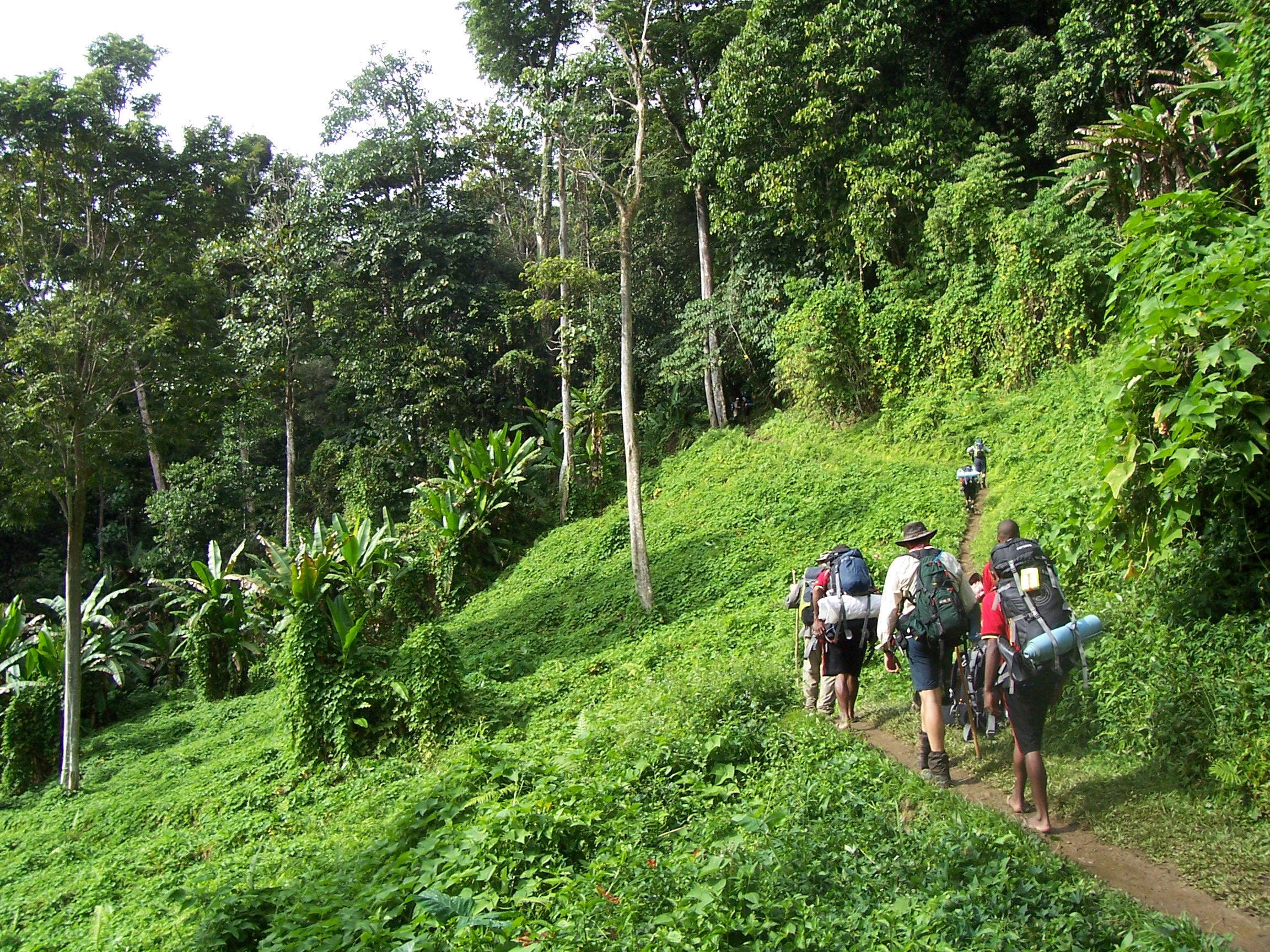
Trekkers with packs walking through green forest on the Kokoda Track between Kokoda and Isurava
Source: Wikimedia Commons / Luke Brindley, CC BY-SA, showing walkers on the Kokoda Track between Kokoda and Isurava.
Decide between the full crossing and a short trek
The full Kokoda experience means crossing the mountainous route between Owers Corner and Kokoda over several trekking days. KTA describes the walk as physically and emotionally challenging, with rough terrain and hot, humid conditions throughout the year. That makes the decision less about whether you can spare enough vacation days and more about whether you have the training time, recovery margin, guide structure, and insurance to handle a demanding route.
If you are short on time or want to test the terrain before committing to a full expedition, the official short-trek checklist gives several Owers Corner options. The listed return walks are Goldie River at about 1 hour 10 minutes, Good Water at about 2 hours, Imita Ridge at about 4 hours, and Ua'ule Creek at about 6 hours. Even those short walks are not casual strolls. The checklist still expects a track permit, a hired local guide, suitable communication equipment, and trekkers who are physically and mentally fit.
The full route is shaped by wartime history, village stays or camping, porter support, group pace, and the operator's guiding style. A short walk is better when you want a controlled first contact with the southern end of the track, a memorial-focused day, or a fitness reality check. In both cases, permit and safety questions come before scenery.
Check the permit before you pay
KTA's permit page says Kokoda Track Trek Permits must be purchased by all trekkers. When you join an organised tour, the company usually includes the permit cost in the overall trek price, but that does not remove your need to verify how the permit is handled. Ask for the permit process before you pay a deposit, not after your flights are booked.
The posted basic fees are K350 for international trekkers and K175 for PNG residents and citizens. The short overnight trek option is listed at K35. Charity-fundraiser treks have a fixed K2000 international fee or a fixed K1000 PNG resident fee, and KTA notes that each person in a charity-fundraiser trek must also pay the normal trekker permit fee.
Four questions usually reveal whether the operator has a clean process. Is the permit included in the quoted price? When is the permit submitted to KTA? Will the operator provide proof of the group permit or receipt? What happens to the permit fee if dates change or the trek is cancelled? Because pages, office practice, and field conditions can move at different speeds, recheck fees and permit handling with the operator and KTA contact details before final payment.
Choose a licensed operator on evidence
KTA says trekking must be undertaken with a licensed tour operator, and its planning page warns that an unlicensed company may be stopped on the track. Price is therefore only one part of the comparison. You need evidence that the company has a current Commercial Operations Licence, publishes or confirms maximum group size, explains the experience of guides and trek leaders, and has a clear emergency communication plan.
Operators can also offer very different trips. Some focus on military history, some on village culture, natural heritage, guesthouse accommodation, camping, porter-supported walking, or a faster athletic itinerary. KTA tells trekkers to check what is included and excluded in the price. A cheap quote can become expensive if permits, food, accommodation, porter wages, airport transfers, domestic transport, or emergency support are vague.
Avoid plans that rely on improvising locally without a licensed operator. KTA does not encourage trekking without an operator because of safety concerns and limited benefit to local communities. Before booking, keep written answers on the operator name, licence status, permit handling, guide assignment, communication equipment, evacuation procedure, porter arrangements, and what happens if weather or illness slows the group.
Plan the direction and transport
The track links Owers Corner in Central Province with Kokoda in Oro Province. KTA's access guidance says Papua New Guinea's international gateway is Jacksons International Airport in Port Moresby. Depending on the tour company's schedule, trekkers may fly or travel toward Kokoda and walk south to Owers Corner, or start from Owers Corner and finish toward Kokoda.
For the Kokoda side, Girua Airport and Popondetta often matter. KTA says Girua Airport is about 30 minutes by road outside Popondetta, and Popondetta to Kokoda is approximately four hours by Public Motor Vehicle. That does not mean every itinerary should be timed to the minute. Domestic flights, road conditions, pickup arrangements, daylight, and weather can all change the feel of the transfer.
Do not count the first and last travel days as simple trekking days. Build in Port Moresby arrival time, domestic connection or road transfer, access to the starting point, pickup at the finish, and a buffer before your international flight. Ask the operator exactly where the group meets, who handles delays, and whether hotel nights before and after the trek are included.
Build training, health, and insurance into the booking
KTA's training page describes the terrain as rough and the climate as hot and humid year round. It strongly recommends a full medical check before the trek or before starting a training programme, and it advises trekkers to seek specialist health advice for Papua New Guinea trekking. This applies even if you hike often at home, because Kokoda combines heat, mud, repeated climbs, remote sections, and emotional fatigue.
Training should be counted backward from departure. KTA notes that some tour companies offer training programmes starting 6-12 months before the walk, and its planning page says people who are already reasonably fit normally train for at least three months, while many train for at least six months or longer. Include hills, stairs, wet shoes, consecutive walking days, load carrying, and heat management rather than only flat mileage.
Insurance is part of the route decision, not a paperwork task. KTA says all trekkers must carry comprehensive medical and travel insurance. Read the policy for trekking coverage, Papua New Guinea coverage, emergency evacuation, helicopter or aircraft evacuation wording, pre-existing conditions, cancellation terms, and who must approve evacuation decisions. Carry policy details in a form your trek leader can use if you cannot speak for yourself.
Carry the short-trek rules into the full-route mindset
The short-day checklist is useful even for people booking the full crossing because it shows what KTA considers basic risk control. It lists the track permit, physical and mental fitness, a hired local guide, optional porter support, satellite phone or appropriate communication device, and a pack-weight limit of 22.5 kg per trekker.
The same checklist lists service fees of K70 per day for a local guide and K50 per day for a local porter. Those numbers are not a complete full-expedition price list, but they are a reminder that local labour, safety responsibility, and porter welfare should be visible in the operator's quote. Ask how porters are paid, what equipment they receive, where they sleep, how much they carry, and whether their food is included.
Communication deserves a direct question. In forest, valleys, heavy rain, and remote villages, a normal mobile signal may not be enough. Ask what device the leader carries, who receives updates, what happens if someone cannot continue, and who has the authority to slow, stop, or evacuate the group.
Respect communities and wartime sites
Kokoda is a trek, but it is also a lived-in corridor and a place of wartime memory. KTA's responsible trekking guidance focuses on tourism that benefits Kokoda communities without damaging the environment or culture. It asks visitors to learn about Papua New Guinea, understand local dress and religion, spend locally where possible, reduce environmental impact, protect wildlife and habitats, and think about rubbish and biodegradable products.
Photography is part of that respect. KTA tells trekkers not to treat people as scenery and to ask permission first. Follow your local guide's advice around villages, homes, children, memorials, grave areas, and ceremonies. The Australian government heritage page explains that the Kokoda fighting ran from 21 July to 16 November 1942 and involved heavy casualties. Knowing that context helps keep the walk from becoming only a fitness challenge.
Use the booking conversation to test responsible travel claims. Ask whether the operator uses local guides and porters, how village accommodation is paid, how rubbish is removed, how cultural briefings are handled, and whether the route avoids unnecessary damage to gardens, water sources, and memorial areas.
Common mistakes that change the trip
Assuming the permit is included without asking when it is submitted and how it is proved.
Choosing an operator by price while leaving the licence status unclear.
Compressing international arrival, domestic transfer, road movement, and the first walking day into one fragile plan.
Training only on flat paths and skipping humidity, mud, stairs, consecutive days, and pack weight.
Buying insurance without reading the trekking, evacuation, Papua New Guinea, cancellation, and pre-existing-condition wording.
Treating village photos, rubbish, and porter welfare as the operator's problem instead of shared responsibilities.
What to recheck before you go
One month before departure, confirm the operator's licence status, permit application, final itinerary, domestic flights or road transfer, porter arrangements, and pack-weight guidance. One week before departure, recheck KTA notices, weather, track conditions, your health status, insurance certificate, emergency contacts, and the exact meeting point in Port Moresby or at the operator's hotel.
Prices and procedures can change. Permit fees, short-trek fees, operator licence lists, road transfers, and flight routings are all volatile enough to recheck against the official page and the operator's current written instructions. If they conflict, ask the operator to resolve the difference in writing before you leave.
The decision rule is simple. Choose the full crossing only when the operator, permit, training plan, insurance, communication equipment, porter structure, and evacuation process are all clear. Choose a short Owers Corner walk only when permit, local guide, communication, timing, and return transport are confirmed. If those answers are vague, the better operator is the one that gives verifiable details, not the one with the louder promise.