KLIA Ekspres or Transit: ticket and terminal transfer guide
Use this guide if your Kuala Lumpur airport plan depends on choosing the right Express Rail Link train before you land.
ByMomentBook Editorial·Published
Use this guide if your Kuala Lumpur airport plan depends on choosing the right Express Rail Link train before you land. The important decision is not simply “take the train”; it is whether KLIA Ekspres, KLIA Transit, or the short KLIA T1-T2 rail hop matches your terminal, station, arrival time, and ticket type.
The main constraint is that the two services share airport stations but do not behave like one interchangeable ticket. KLIA Ekspres is built around the KL Sentral-airport run, while KLIA Transit is the all-stops service for Bandar Tasik Selatan, Putrajaya & Cyberjaya, Salak Tinggi, and late-night pattern checks. Prices, validity, child handling, and last-train timing should be checked on the official KLIA Ekspres pages on the day you travel.
What to know first
KLIA Ekspres is the simple choice between KL Sentral and KLIA T1 or KLIA T2 when you want the direct airport train during regular service hours.
The official KLIA Ekspres page lists a 28-minute run between KL Sentral and KLIA T1, plus 3 minutes between KLIA T1 and KLIA T2.
KLIA Transit serves KL Sentral, Bandar Tasik Selatan, Putrajaya & Cyberjaya, Salak Tinggi, KLIA T1, and KLIA T2, so use it when one of those intermediate stations is your real origin or destination.
The standard KL Sentral-airport fare is RM55 adult single, RM100 adult return, RM25 child single, and RM45 child return; children below 6 travel free within the official adult-ticket limits.
KLIA Ekspres and KLIA Transit tickets are not interchangeable, so a change of plan to Putrajaya, Bandar Tasik Selatan, or Salak Tinggi can require a new KLIA Transit ticket.
From 23:00 (11:00 pm), the operator notes that KLIA Ekspres trains stop at all stations and late services are extended from KLIA T1 and T2, so always check the full schedule for late arrivals.
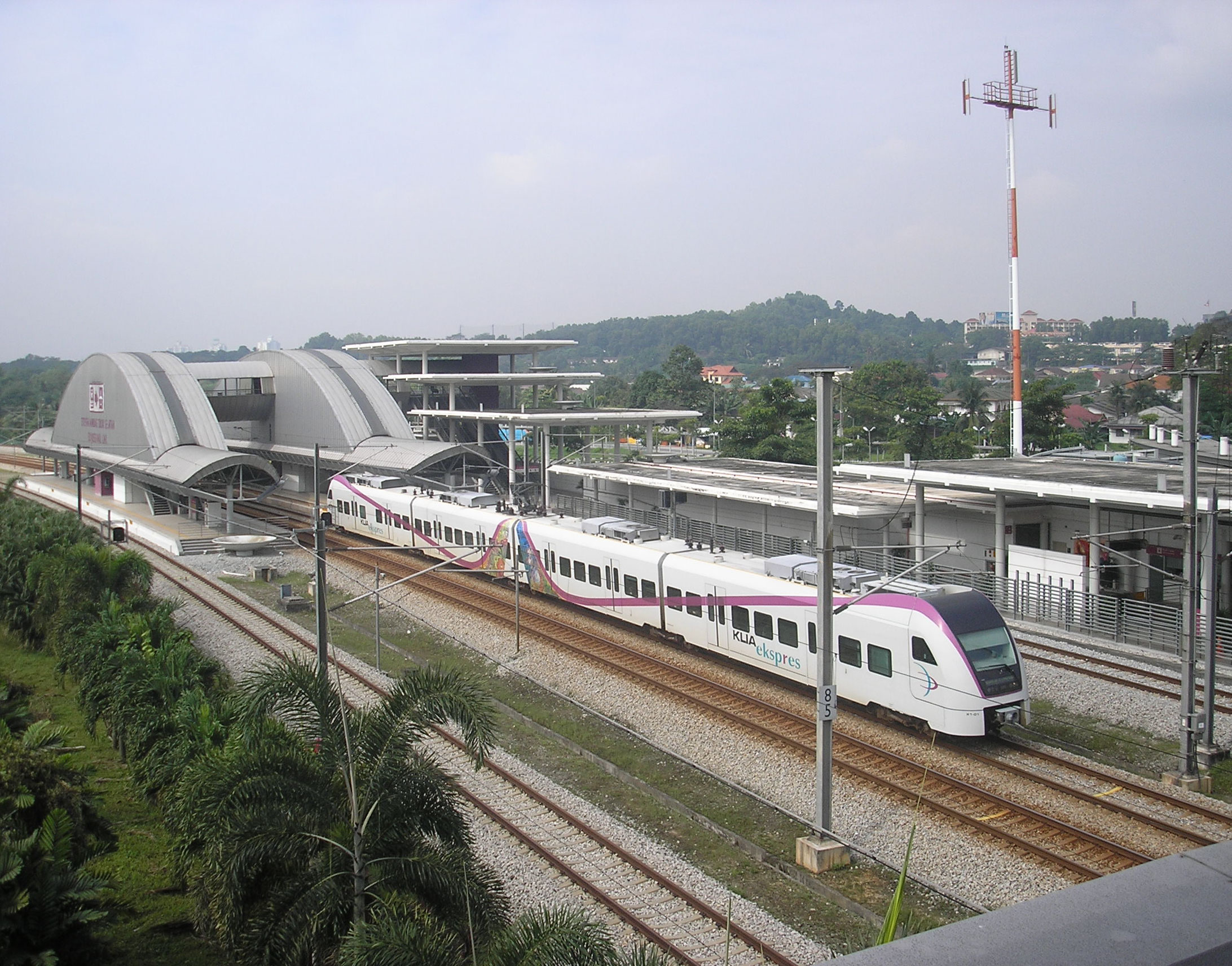
KLIA Ekspres train standing at Bandar Tasik Selatan station on the airport rail line
Source: Wikimedia Commons / Two hundred percent, CC BY-SA 2.5, showing the ERL airport rail line at Bandar Tasik Selatan.
Choose Ekspres, Transit, or the terminal hop
Choose KLIA Ekspres when your trip is simply KL Sentral to the airport, or the airport to KL Sentral, and you do not need an intermediate stop. It is the cleanest ticket decision for most visitors staying near KL Sentral, transferring to the LRT, MRT, KTM Komuter, monorail connection, or using a hotel pickup nearby.
Choose KLIA Transit when Bandar Tasik Selatan, Putrajaya & Cyberjaya, or Salak Tinggi is part of the plan. This matters for travellers using Terminal Bersepadu Selatan, staying in Putrajaya, commuting to Cyberjaya, or meeting someone outside central Kuala Lumpur. The journey from KLIA T2 to KL Sentral is listed as 39 minutes because the train stops at the intermediate stations.
Use the KLIA T1-KLIA T2 rail hop only when you need to move between airport terminals and prefer the train over airport walking, shuttle, or taxi options. The KLIA Transit fare table lists the T1-T2 sector at RM2 adult and RM1 child. Build in walking time from baggage claim, immigration, and platform access because the 3-minute rail segment is only the time on the train.
Buy and use the ticket without surprises
For KLIA Ekspres, the official standard fare between KL Sentral and KLIA T1 or T2 is RM55 for an adult single and RM100 for an adult return. Children aged 6-15 are listed at RM25 single and RM45 return, while children below 6 travel free under the operator's conditions, with a maximum of three free child tickets per adult ticket.
Online KLIA Ekspres tickets bought through the website or app are listed as valid for 1 month from the selected travel date. Standard counter and kiosk validity is also shown as 1 month from the purchase date, while a return trip must be used within the official validity window. Once you enter the gate, the ticket is valid for 90 minutes from entry to exit.
Three ticket rules change the practical plan:
A KLIA Ekspres sector between KL Sentral and KLIA T1/T2 can be used in either direction because the fare is the same.
KLIA Ekspres and KLIA Transit tickets are not interchangeable, so do not buy Ekspres if the real destination is Putrajaya, Salak Tinggi, or Bandar Tasik Selatan.
Seat reservation is not required, and the listed terms say purchased tickets are non-refundable.
Plan the timing and last-train window
During regular published service, KLIA Ekspres is listed as running every 20 minutes all day, every day, including weekends and national public holidays. The product page gives first and last train summaries of 05:00-00:00 from KL Sentral, 04:55-00:00 from KLIA T2 toward KL Sentral, and 05:00-00:05 from KLIA T1 toward KL Sentral.
The late-evening detail is the part many travellers miss. The same official page says that from 23:00 (11:00 pm) all KLIA Ekspres trains stop at all stations, with service extended until 01:00 (1:00 am) from KLIA T1 and T2. That means the last usable train for a delayed flight may behave more like a Transit stopping pattern than the daytime non-stop service.
For KLIA Transit, the product page lists trains every 15 minutes during weekday peak hours and every 30 minutes during weekday off-peak hours and weekends. It also shows first and last sample times by station, including a first KL Sentral departure at 05:03 and a last KLIA T2 departure reaching KL Sentral at 01:09. Use the downloadable schedule, not memory, when the flight lands near midnight.
Move through KL Sentral and the airport terminals
At KL Sentral, treat KLIA Ekspres and KLIA Transit as two related but separate decisions. If you bought an Ekspres ticket, follow the KLIA Ekspres/KL City Air Terminal side rather than assuming every ERL gate takes every airport-rail ticket. If your trip starts on LRT, MRT, KTM, monorail, or a taxi, allow station transfer time before the 28-minute train ride begins.
At the airport, confirm whether your airline uses KLIA T1 or KLIA T2 before buying or tapping in. KLIA Ekspres reaches KLIA T1 first, then KLIA T2 three minutes later. If you are meeting someone at the other terminal, include the paid T1-T2 rail sector or another terminal-transfer option in your plan instead of treating the airport as one single platform.
For arrivals, separate three clocks: immigration and baggage time, the walk to the ERL station, and the published train schedule. A 28-minute express rail time is useful only after you are on the platform with a valid ticket. Families should add time if they need child ticket help at a counter, especially for children below 6 who need the free-ticket handling described in the terms.
Rules and exceptions that change the trip
Children aged 6-15 use the listed child fare. Children below 6 can travel free, but the operator's terms explain that free child tickets are tied to an adult ticket, may require counter handling, and proof of age can be requested. If a child needs to pass independently through a gate, do not leave the ticket issue until the train is already due.
Online purchases have transaction limits, including a maximum of 10 tickets per transaction or RM700 per day per credit/debit card, bank account, or digital wallet. Groups larger than that should not assume one last-minute web purchase will clear for everyone.
Fares are also explicitly subject to change. Treat RM55, RM100, RM25, RM45, RM2, and RM1 as source-checked figures, not permanent travel advice. If your article, itinerary, or group brief will be used later, recheck the official fare page before relying on those numbers.
Common mistakes
The most common mistake is buying the faster-looking train without checking the station. KLIA Ekspres is right for KL Sentral, but KLIA Transit is the service that actually serves Bandar Tasik Selatan, Putrajaya & Cyberjaya, and Salak Tinggi.
A second mistake is assuming “airport train” means a free terminal shuttle. The T1-T2 sector is shown in the KLIA Transit fare table as RM2 adult and RM1 child. That fare is small, but missing it can matter when you are moving between terminals on a tight connection.
A third mistake is using the daytime express timing for a late-night arrival. After 11:00 pm the stopping pattern changes, and the downloadable schedule should become the plan. If the flight is delayed, check the service status and full schedule before rejecting bus, taxi, e-hailing, or hotel transfer alternatives.
Who should choose which option
Choose KLIA Ekspres if you are staying near KL Sentral, carrying luggage, or connecting immediately to central Kuala Lumpur rail lines. It is also the easiest choice when you value a simple fare and a direct platform-to-platform airport link.
Choose KLIA Transit if your destination is Putrajaya, Cyberjaya, Bandar Tasik Selatan, Salak Tinggi, or a bus connection at TBS. The fare matrix can be cheaper for intermediate sectors, and the all-stops pattern prevents a backtrack through KL Sentral.
Choose the T1-T2 rail hop when the terminal change is the whole job. Pay attention to the fare, then add enough walking and waiting time. For very tight international-domestic or domestic-international connections, the train time alone should never be treated as the full transfer time.
What to check before you go
Open the official KLIA Ekspres schedule page on the travel date, especially for travel after 11:00 pm, public holidays, or periods with engineering changes. The homepage also displays train service status, which is worth checking before you leave the hotel or airport arrivals hall.
Recheck the fare page if you are buying for a family, group, or child. Confirm the adult/child ages, free-child conditions, transaction limit, refund rule, and whether counter activation is needed for a child barcode. If your destination changed after purchase, verify whether the existing ticket can still be used or whether a KLIA Transit ticket is required.
Finally, check your terminal before buying. KLIA T1 and KLIA T2 are both served by ERL, but your airline terminal decides whether you get off at the first airport stop or continue three more minutes. That small detail is often the difference between a calm airport exit and a paid terminal correction under time pressure.