Iceland Ring Road Driving Guide 2026: Route 1 Pace, Road Checks, and When a 4WD Actually Helps
Iceland is one of those places where self-driving looks simple on a map and much harder once you start reading the official safety advice. That gap matters.
ByMomentBook Editorial·Published·Updated
Iceland is one of those places where self-driving looks simple on a map and much harder once you start reading the official safety advice. That gap matters. The Ring Road can give first-time visitors a remarkable amount of freedom, but only if you treat weather, road conditions, gravel transitions, and seasonal limits as part of the trip instead of as background detail.
The clearest picture comes from Visit Iceland and Safetravel together. Visit Iceland frames independent travel as realistic and says small 2WD cars are fine in summer on most major routes, while a 4WD gives more freedom. Safetravel, the official source for safe travel in Iceland, adds the discipline that makes that freedom work: check conditions often, respect closures, understand local road signs, and do not confuse the Ring Road with every remote detour you see online.
What to know first
Visit Iceland says most visitors arrive via Keflavik International Airport (KEF), the country’s main gateway.
Visit Iceland says small 2WD vehicles are fine over summer for most major routes, while a 4WD allows more freedom.
Visit Iceland says fourteen days is enough time to explore many beautiful sights around Iceland.
Safetravel says weather and road conditions in Iceland can change fast, and its app can send your GPS location to 112 emergency services.
Safetravel says you should never stop in the middle or on the side of the road for photos unless it is a safe place to stop.
Safetravel says you need to slow down when paved roads turn to gravel and when approaching single-lane bridges.
Safetravel says off-road driving is strictly forbidden.
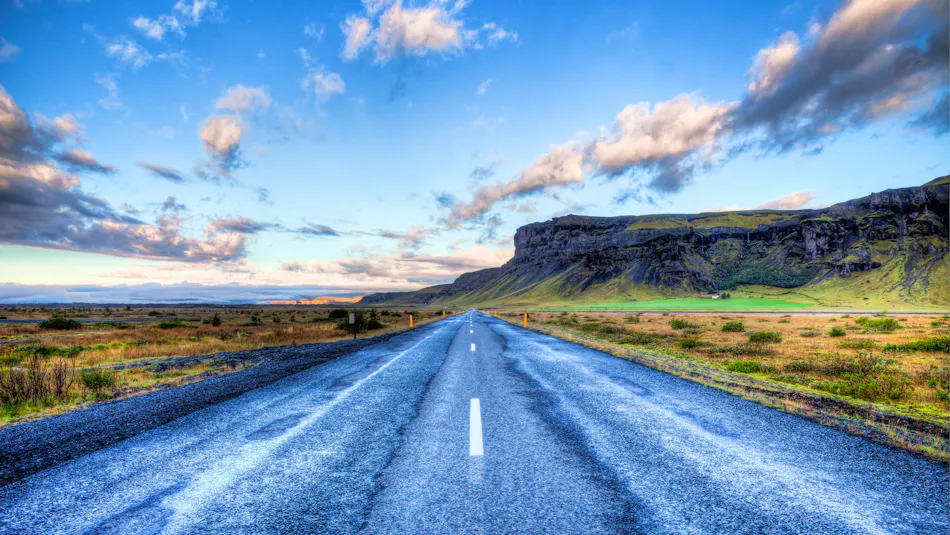
Two-lane road crossing open Icelandic landscape beneath cliffs
*Image source: Visit Iceland*
Treat the Ring Road as your main spine, not as a promise to see everything
For a first trip, the safest way to think about Route 1 is as the main spine of the journey. It supports a large share of Iceland’s classic self-drive logic, but it does not make every side road equally simple, and it does not remove the need to choose. Iceland looks compact on a screen, yet wind, gravel, one-lane bridges, weather alerts, and long daylight drives can make a day feel much bigger than the mileage suggests.
That is why a disciplined plan usually works better than a heroic one. If you land at KEF and immediately try to turn the whole island into a nonstop checklist, you are more likely to carry fatigue into the days when you need concentration most. A calmer plan keeps the Ring Road useful instead of turning it into pressure.
Choose a pace that matches the island
Visit Iceland’s official 14-day around-Iceland guide is a useful benchmark. A practical inference from that benchmark is that shorter trips need selectivity, not optimism.
If you only have about 5 to 7 days, a partial loop or an out-and-back plan is often smarter than forcing a full circle.
If you have roughly 8 to 10 days, a full Ring Road drive can work, but only if you keep detours limited and accept that some regions will be brief.
If you have 12 to 14 days, you have much more room for weather adjustments, slower scenic stops, and overnight gaps that reduce fatigue.
This is not about being conservative for its own sake. It is about matching the pace to the actual conditions Iceland’s own official sources keep warning you about.
2WD, 4WD, and why F-roads are a separate question
One of the most useful official clarifications is that a normal summer Ring Road trip and highland driving are not the same decision. Visit Iceland says small 2WD vehicles are fine for most major routes in summer, while 4WD gives more freedom. Safetravel then draws the harder line: F-roads are very different, conditions change quickly, not all 4WD vehicles are suitable, and river crossings are always your own risk.
Safetravel also says F-roads are usually closed from mid-September until June or July, depending on area and conditions. That means many first-time visitors do not need to think of F-roads as an automatic part of a Ring Road itinerary at all. In practice, the cleaner approach is this:
choose 2WD for a summer trip that stays on major roads and standard access routes
choose 4WD when your season, accommodation pattern, or planned detours genuinely justify it
treat F-roads as a separate highland project that requires route checks, vehicle suitability, and much more caution
If your itinerary only works because you assume every interior road will be open and comfortable, the itinerary is weak.
The daily routine that matters more than a perfect itinerary
In Iceland, the best driving habit is not confidence. It is re-checking. Safetravel says conditions can change fast, and that is the operational fact that should shape every morning.
A practical first-timer routine is simple:
check road and weather conditions before leaving accommodation
check again later in the day if you are crossing exposed or remote sections
keep headlights on at all times
keep every passenger buckled
keep phones out of the driver’s hand
use the Safetravel app and know that it can share your GPS location with 112 in an emergency
If you are planning a longer rural day, it is also sensible to tell someone where you expect to end up. That is especially true when the plan depends on the weather staying stable.
Know the signs that change your day
A lot of Iceland driving stress disappears once you know which official warnings actually matter.
Safetravel highlights several that first-time drivers should take seriously. A closed road means closed. A sign showing a paved road changing to gravel means slow down before the surface changes, not after the tires lose grip. A single-lane bridge sign means you should reduce speed, and Safetravel’s driving guidance says the car that arrives first has the right of way. Signs for unbridged rivers are even more important because Safetravel says those crossings are only suitable for bigger 4x4 vehicles, and damage in river crossings is not insured.
The photo rule matters too. Iceland’s landscapes constantly tempt people to stop abruptly, but Safetravel explicitly warns against stopping in the road or at unsafe shoulders just to take pictures. On a first trip, that single habit may protect you more than any fancy route optimisation.
What to double-check before you drive away from KEF
Before the trip begins, double-check:
whether your number of days supports a partial route better than a full loop
whether your vehicle choice matches the roads you will actually drive, not the roads you imagined
whether any planned detour depends on F-road openings or river crossings
whether everyone in the car understands gravel transitions, single-lane bridges, and the no-photo-stop rule
whether you have checked same-day road and weather conditions instead of relying on last week’s plan
The strongest Iceland Ring Road trip is usually not the one that tries to prove something. It is the one that uses Route 1 as a reliable backbone, leaves margin for weather and road reality, and treats official safety guidance as part of the itinerary rather than as fine print.