Grenada Underwater Sculpture Park MPA Fee and Snorkel Guide
If you want to see Grenada's underwater sculptures in the Molinere/Beauséjour Marine Protected Area, the first decision is not only which tour looks attractive.
ByMomentBook Editorial·Published
If you want to see Grenada's underwater sculptures in the Molinere/Beauséjour Marine Protected Area, the first decision is not only which tour looks attractive. You need to decide whether a guided snorkel boat, scuba dive, glass-bottom boat, or yacht stop matches your swimming confidence, fee handling, supervision needs, and schedule.
This guide is for first-time visitors staying near St. George's, Grand Anse, or arriving by cruise who want the main underwater sculpture park on Grenada island, not the separate Carriacou installation. The main constraint is that MPA user fees are being phased upward on official dates, while tour prices may or may not include every entry, activity, or mooring charge.
What to know first
The Molinere/Beauséjour underwater sculpture park is inside a marine protected area and is presented by the Grenada Tourism Authority as one of Grenada's major snorkel sites.
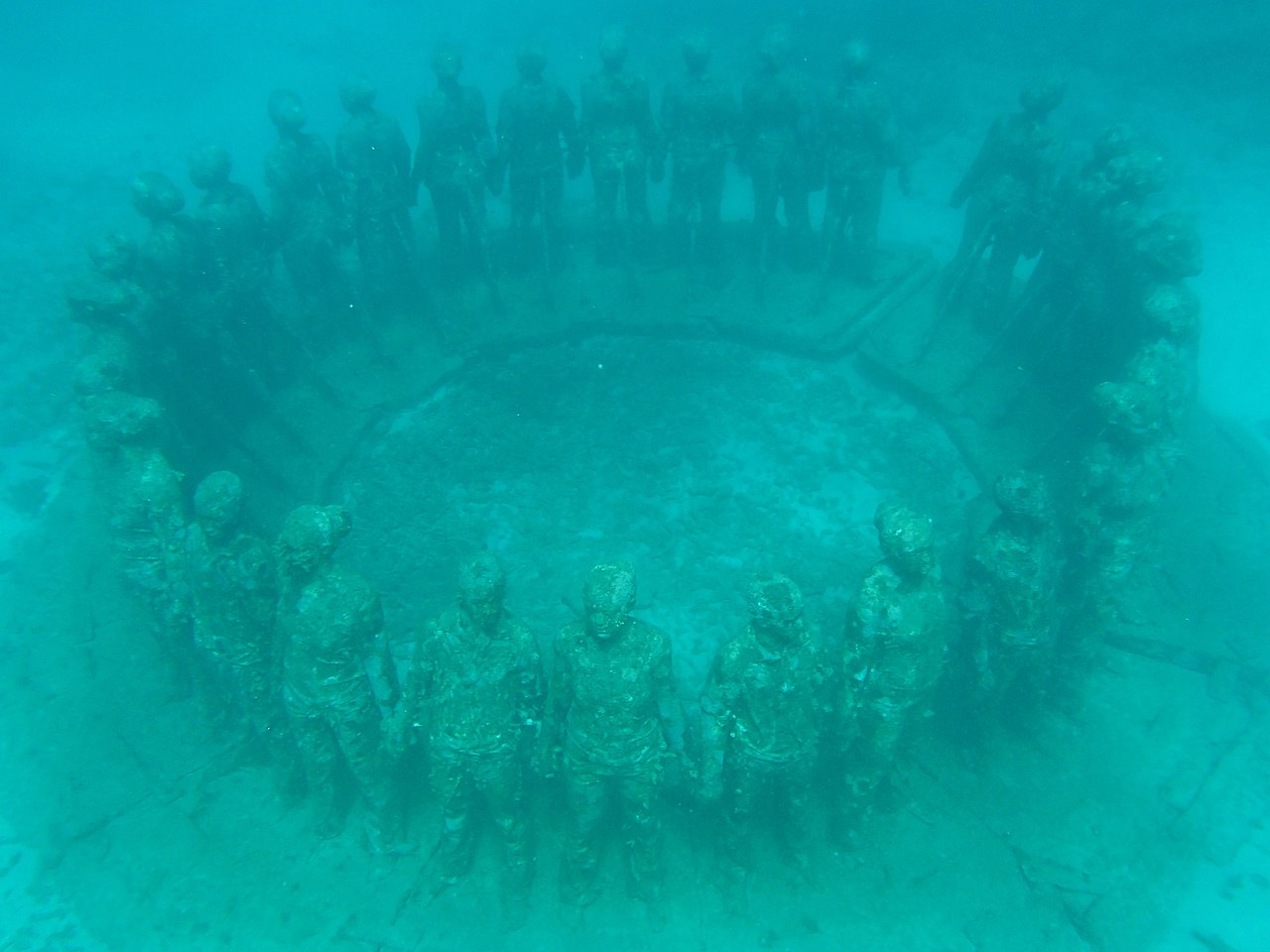
The original park was created by Jason deCaires Taylor and installed in 2006; the tourism authority describes concrete and rebar artworks that also act as substrate for marine life.
As checked on June 8, 2026, the GTA fee release sets the MPA entry user fee at US$3.50 per person per visit from May 15, 2025, rising to US$7 on October 1, 2026 and US$10 on October 1, 2027.
The GTA payment portal says its products are priced in Eastern Caribbean dollars and currently shows a Marine Protected Park Fee product at $10.00, so verify the checkout currency and total before you go.
The same fee release also lists separate activity-related fees for scuba, snorkel, other vessels, and yacht buoy or mooring use; ask your operator exactly which fees are included.
Protected-area summaries prohibit taking or damaging animals, plants, artifacts, coral, sand, and rock; they also restrict anchoring, mooring, dumping, jet skis, and unsupervised diving or snorkeling.
Circular underwater figure sculptures standing in blue water at Molinere Underwater Sculpture Park
Source: Boris Kasimov photograph on Wikimedia Commons, CC BY 2.0.
Choose snorkel, glass-bottom boat, scuba, or yacht stop
A guided snorkel boat is the most practical default for many visitors. The sculptures are reachable in shallow water for snorkelers, and a local boat tour normally handles the approach, equipment, briefing, and time in the water. It works well if you can swim but do not hold a scuba certification, if you are visiting with older children, or if you only have a half day from Grand Anse, St. George's, or the cruise port.
Scuba is better when you want more controlled time below the surface and are comfortable with certification checks, gear, and dive-operator procedures. Ask whether the quoted price includes the MPA entry user fee and the scuba activity fee mentioned in the GTA release. Also ask about maximum group size, depth, cancellation rules, and whether the dive includes only the sculpture park or another reef site as well.
A glass-bottom boat is the right compromise when someone in the group does not want to get wet, cannot swim, or wants a lower-effort look at the site. The tradeoff is that visibility depends heavily on weather, water clarity, and where the boat can safely position. Treat it as a viewing experience, not as a substitute for being in the water among the works.
A yacht stop can be attractive if you are already sailing the west coast, but it creates the most rule and fee questions. The official fee release mentions yacht buoy or mooring use, and the protection summaries warn against anchoring damage and mooring away from permitted buoys. Before entering the MPA, ask the captain how the fee is paid, which buoy is allowed, and what the no-anchor rule means at that point.
Budget the MPA fee and payment check
The confusing part of this visit is that the official pages express the fee system in more than one way. The GTA press release gives a phased MPA entry user fee in US dollars: US$3.50 from May 15, 2025, US$7 from October 1, 2026, and US$10 from October 1, 2027. The GTA payment portal states that product prices are in Eastern Caribbean dollars and shows Marine Protected Park Fee at $10.00. For a June 2026 trip, treat that as a checkout item to verify, not as a reason to ignore the release.
Before you reserve, ask four direct questions. Is the MPA entry user fee included in the tour price? Is the snorkel, scuba, glass-bottom boat, kayak, free-diving, or yacht mooring fee separate? Will you receive a GTA portal receipt, or does the operator handle payment in bulk? If your visit is on or after October 1, 2026, has the operator already updated the quote for the next fee step?
Keep the answer in writing, even if it is a short message. A fee misunderstanding is easier to fix before you board than when the boat is waiting, the sea state is changing, and staff are trying to check in several groups. If the payment portal is used directly, save the receipt and a screenshot showing date, currency, item name, and total.
Plan the boat route and the exact site
Molinere/Beauséjour MPA is on Grenada's south-west coast in St. George parish. CATS describes the protected area as covering marine areas around Beauséjour, Flamingo, and Dragon Bays. That matters because tour listings may say Molinere Bay, Grand Mal, underwater sculpture park, or MPA, while the pickup may be Grand Anse, St. George's harbor, a hotel dock, or the cruise terminal.
Do not confuse this site with Carriacou's A World Adrift. The Grenada Tourism Authority also promotes that separate underwater sculpture installation off northern Carriacou, with 30 boat sculptures and access by boat from Hillsborough. It can be a good experience if you are staying on Carriacou, but it is not the same half-day plan as the original Molinere park on Grenada island.
Sea conditions are part of the route decision. Rain, wind, swell, and runoff can change visibility and boat comfort even when the tour still runs. If photos are important, ask the operator what time normally gives the best light and clarity in current conditions, but do not treat any answer as a guarantee. A flexible second day in Grenada is more useful than a perfect spreadsheet plan.
Follow the protected-area rules in the water
The sculptures are not props in a swimming pool. They sit inside a protected marine area where the purpose is conservation, managed use, education, and reduced pressure on natural reefs. ProtectedSeas summarizes restrictions that prohibit taking animals or plants, damaging animals or plants, removing artifacts, removing coral, rock, sand, or other calcareous material, dumping waste, and causing anchor damage.
For snorkelers, the practical rule is to control your fins and your camera. Keep enough distance that you do not kick sand into the scene, strike a sculpture, or force another swimmer onto coral. Do not stand on the seabed around the works. If the group forms a circle around a famous installation, wait for space rather than pushing through for a photograph.
For divers, the same principle applies with buoyancy rather than fins alone. Avoid touching the sculptures, do not wedge a hand into a crevice to hold position, and follow the dive leader's route. The point of the sculpture park is that marine life slowly occupies the structures; contact that feels harmless to a visitor can still damage fragile growth.
For boaters, the key rule is to use the correct mooring and avoid anchoring. If a skipper cannot explain where commercial and non-commercial boats are allowed to moor, ask more questions before entering the site. A low-cost stop that ignores the MPA system is not a good deal.
Avoid common planning mistakes
The first mistake is booking the wrong island. "Grenada underwater sculpture park" can refer to the original Molinere park on Grenada island or the newer A World Adrift installation off Carriacou. Check the departure island, transfer time, and operator address before you pay.
The second mistake is assuming "park fee included" covers everything. The official release separates the MPA entry user fee from several activity fees and mooring-related charges. A snorkel tour, scuba dive, yacht stop, and glass-bottom boat may not handle those charges in the same way.
The third mistake is planning independent access because the site looks close on a map. The legal summary links snorkel and scuba activity to qualified supervision, and the route involves boats, currents, visibility, and other users. A guided operator is not only a convenience; it is part of respecting the protected-area system.
The fourth mistake is treating the fee schedule as static. Any article, hotel handout, or tour description written before the 2025 release may be missing the phased fee changes. For visits after October 1, 2026 or October 1, 2027, old prices are especially risky.
Who should choose which option
Choose a guided snorkel boat if you want the core sculpture park experience with the least planning friction. It is the best fit for confident surface swimmers, families with suitable-age children, and travelers who want a half-day activity with clear equipment support.
Choose scuba if you are certified, comfortable with dive logistics, and want more time below the surface. It is worth paying attention to the operator's environmental briefing, group ratio, and whether the dive is designed around the sculptures or bundled into a broader reef itinerary.
Choose glass-bottom viewing if comfort matters more than immersion. It is sensible for mixed-ability groups, non-swimmers, and travelers who want to share the outing without putting everyone in the water. Keep expectations flexible because visibility is the whole experience.
Choose a yacht stop only if the captain understands the MPA rules, buoy system, and fee payment. The protected-area rules are more important than the convenience of being near the site already.
What to check before you go
Recheck the GTA payment portal 24 to 48 hours before departure. Confirm the Marine Protected Park Fee item, the displayed currency, and whether your operator needs an individual receipt. Then confirm whether your booking includes MPA entry, snorkel or scuba activity charges, vessel charges, and mooring charges.
Ask the operator for the day's sea-state call, not only the scheduled departure time. A responsible operator should be able to explain visibility, wind, swell, rain effects, and the backup plan if Molinere is not comfortable. If the answer is vague, keep the schedule flexible and do not make the sculpture park your only possible sea day.
Finally, carry the mindset that this is a marine protected area first and an attraction second. The best tour is the one that explains the rules clearly, manages payment without surprises, keeps swimmers supervised, and leaves the sculptures and reef life untouched for the next group.