
Travel Guide
Dar es Salaam to Zanzibar Ferry Guide: Tickets, Luggage, and Booking Rules
The Dar es Salaam-Zanzibar fast ferry is useful when you want to reach Stone Town without adding an island-side airport transfer.
ByMomentBook EditorialPublishedUpdated
The Dar es Salaam-Zanzibar fast ferry is useful when you want to reach Stone Town without adding an island-side airport transfer. The practical decision is whether your ticket is paid and confirmed, your seat class fits your comfort and luggage, your bags stay within the official allowance, and your schedule leaves room for port checks. Azam Marine & Kilimanjaro Fast Ferries is the official operator source used here: its pages confirm daily commutes between Dar es Salaam, Zanzibar, Pemba, and Tanga, passenger classes, age bands, 25 kg luggage, payment confirmation, and cancellation rules.
What to know first
- Azam Marine states that it offers daily commutes to and from Dar es Salaam, Zanzibar, Pemba, and Tanga.
- The official rates page defines children as 5 to 11, adults as 12 and above, and says children under 5 are not eligible for ticket bookings.
- Non-resident fares are USD 35 Economy, USD 40 Business, USD 60 VIP, and USD 100 Royal.
- Permitted luggage is 25 kg per person, and extra luggage is chargeable.
- Online bookings are not confirmed until payment has been made.
- Missed travel dates or times are not refunded, and cancellations should be raised two hours before departure.
- The Dar es Salaam office is opposite St. Joseph Cathedral on Sokoine Drive.

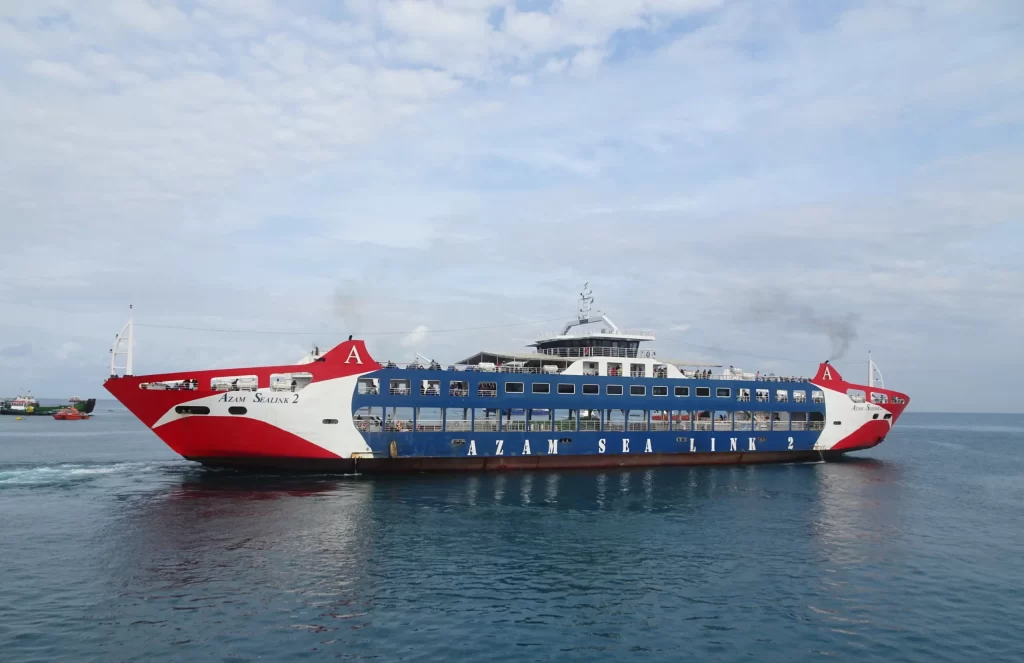
*Image source: Azam Marine & Kilimanjaro Fast Ferries*
Book only when payment is complete
Online bookings are not confirmed until payment has been made. This means a selected sailing is not enough until the official channel has issued a paid ticket. Use the operator site, non-resident booking link, WhatsApp, or office, and recheck name, date, direction, class, and payment state.
Choose the class by comfort and luggage
Non-resident fares are USD 35 Economy, USD 40 Business, USD 60 VIP, and USD 100 Royal. Economy is the baseline, Business is a small upgrade when available, and VIP or Royal make sense for travellers who value space and calmer boarding. The fleet page warns that service details can vary by route, vessel configuration, and last-minute operations.
Keep bags inside the 25 kg rule
Permitted luggage is 25 kg per person, and extra luggage is chargeable. Keep passport, ticket, phone, payment proof, medicine, valuables, and a light layer in a smaller hand item. If you may exceed the limit, plan for an official extra charge instead of negotiating at the port.
Arrive with port friction in mind
The Dar es Salaam office is opposite St. Joseph Cathedral on Sokoine Drive. Port areas can be busy around popular departures. Missed travel dates or times are not refunded, and cancellations should be raised two hours before departure. Avoid same-hour connections from long buses, domestic flights, or safari vehicles unless you can absorb a missed ticket.
Know what the ferry can and cannot promise
The operator describes modern vessels, online ticketing, navigation equipment, beverages, video entertainment, free internet on catamarans, and VIP lounge features. Treat those as useful possibilities, but confirm any critical service for your actual class and vessel before travel.
Common mistakes
The common errors are buying too late, treating a pending online choice as a ticket, ignoring the 5 to 11 child band and 12 plus adult band, overpacking beyond 25 kg, and planning the route like a casual shuttle instead of a timed sea crossing.
What to check before you go
- Recheck the exact departure time in the official booking channel.
- Confirm the ticket is paid and issued.
- Confirm Dar es Salaam to Zanzibar or the reverse direction.
- Check class, names, and child or adult category.
- Weigh luggage if you may exceed 25 kg.
- Keep a buffer for traffic, port checks, and the two-hour cancellation rule.
- Confirm Wi-Fi, lounge, vessel, or accessibility details if they matter.
Final planning checks
Use this guide as a decision sequence, not as a promise that every counter, gate, platform, trail, or desk will behave the same way on the day you arrive. Start with the official source links, then compare them with your real date, arrival time, group size, mobility needs, luggage, and payment method. If the official page has changed since the checked date, follow the current official page and keep this article as the structure for the questions you still need to answer.
For Dar es Salaam to Zanzibar Ferry Guide: Tickets, Luggage, and Booking Rules, the most useful habit is to keep the practical pieces together. Put tickets, booking references, QR codes, identity documents, pass numbers, screenshots, and the relevant official page in one place before leaving your hotel. If a staff member, driver, guide, ticket desk, or gate agent asks for proof, you should not have to search through email, browser tabs, and photo albums while a queue forms behind you.
Build a time buffer around the strictest point in the plan. That may be last entry, the last return trip, a timed reservation, a maintenance window, a ferry or train connection, a security check, or the moment when weather makes the experience less useful. The buffer is especially important when the route has more than one operator, when a holiday schedule is possible, or when the plan depends on a transfer that is easy on a map but slow in real life.
Treat prices and rules as items to verify, not as trivia to memorize. A good travel plan notes the current fare, permit, pass, age rule, discount category, closure day, bag policy, photo rule, and accessibility limit, then checks the official page again before payment. This avoids the common mistake of buying the right product for last season and the wrong product for this visit.
If the visit matters a lot, prepare a fallback that uses the same area instead of rebuilding the whole day from zero. Choose a nearby indoor stop for bad weather, a lighter route for tired companions, a later meal option for a queue delay, and a return plan that still works if the first choice sells out or stops early. The fallback should be simple enough to use without research under pressure.
Finally, read the source section with a practical lens. Official pages answer different questions: one may confirm the price, another the route, another closures, and another visitor rules. Check the page that matches the decision you are about to make, and do not assume that one source covers every operational detail. That habit keeps the article stable while still letting the newest official information control the final choice.
How to use the sections
Use "What to know first" as a checkpoint, not just as background reading. Confirm what decision it supports, what proof or timing it requires, and what you will do if the official source gives a different answer on the travel day.
Use "Book only when payment is complete" as a checkpoint, not just as background reading. Confirm what decision it supports, what proof or timing it requires, and what you will do if the official source gives a different answer on the travel day.
Use "Choose the class by comfort and luggage" as a checkpoint, not just as background reading. Confirm what decision it supports, what proof or timing it requires, and what you will do if the official source gives a different answer on the travel day.
Use "Keep bags inside the 25 kg rule" as a checkpoint, not just as background reading. Confirm what decision it supports, what proof or timing it requires, and what you will do if the official source gives a different answer on the travel day.
Use "Arrive with port friction in mind" as a checkpoint, not just as background reading. Confirm what decision it supports, what proof or timing it requires, and what you will do if the official source gives a different answer on the travel day.
Use "Know what the ferry can and cannot promise" as a checkpoint, not just as background reading. Confirm what decision it supports, what proof or timing it requires, and what you will do if the official source gives a different answer on the travel day.
Use "Common mistakes" as a checkpoint, not just as background reading. Confirm what decision it supports, what proof or timing it requires, and what you will do if the official source gives a different answer on the travel day.
Use "What to check before you go" as a checkpoint, not just as background reading. Confirm what decision it supports, what proof or timing it requires, and what you will do if the official source gives a different answer on the travel day.