Monserrate is one of Bogotá's simplest half-day plans, but the official information is split between two operators.
ByMomentBook Editorial·Published·Updated
Monserrate is one of Bogotá's simplest half-day plans, but the official information is split between two operators. Cerro de Monserrate publishes the funicular, cable car, ticket, and basilica details, while the pedestrian trail is administered by Bogotá's IDRD.
Use this guide before you choose between the rail transport and the stairs. It focuses on the official schedules, ticket prices, trail limits, and maintenance caveats that can shape a first visit.
What to know first
Cerro de Monserrate says the hill is open to the public 365 days a year.
Funicular and/or cable car hours are listed as:
Monday to Saturday: 6:30 AM to 10:00 PM
Sunday: 5:30 AM to 5:00 PM
Holidays: 6:30 AM to 5:00 PM
The ticket office is listed as operating until the same closing times, and the official page warns that schedules can change for maintenance, equipment availability, or unforeseen conditions.
Official Monday-to-Saturday and holiday fares list:
Tickets are sold through the official Monserrate ticket portal.
The pedestrian trail belongs to Bogotá and is administered by IDRD, not by the rail operator.
IDRD lists the trail as 2,350 meters long, with 1,605 steps and 470 meters of elevation gain.
The trail opens Wednesday to Monday at 5:00 AM and closes for ascent at 1:00 PM; Monserrate says descent is allowed until 4:00 PM. Tuesdays are closed for maintenance.
IDRD says the trail does not require advance registration, but capacity is controlled on site.
IDRD restrictions include children under one meter tall, pets, pregnant visitors, people over 75, bicycles, strollers, walkers, skateboards, and similar items.
IDRD also says there are no public bathrooms on the trail itself.
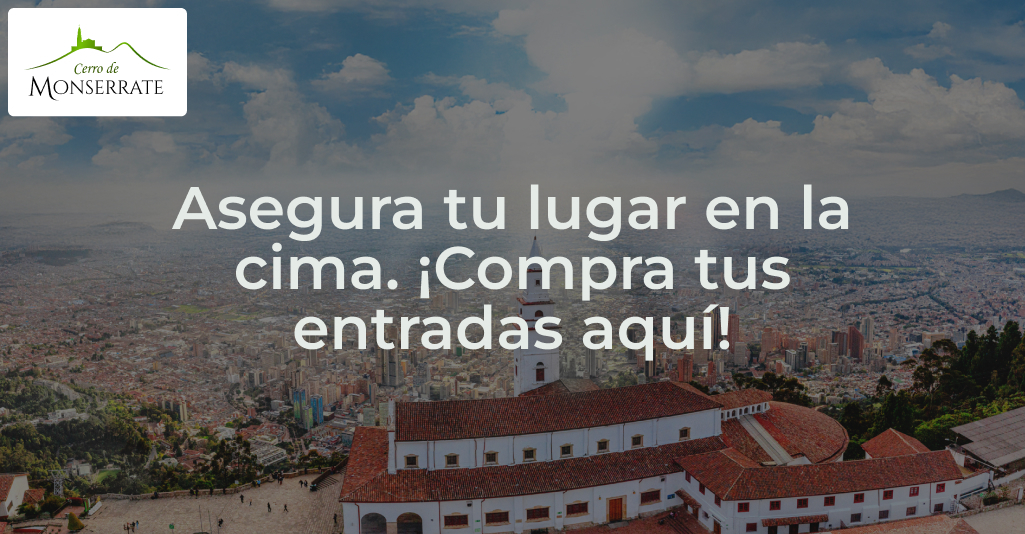
Cerro de Monserrate rising above Bogotá with the sanctuary at the summit
*Image source: Cerro de Monserrate*
Buy through the official ticket portal
For most visitors, the rail ticket is the fixed part of the plan. The Monserrate site links visitors to its official ticket portal, and the same official page lists the current public fares.
Use that portal instead of treating third-party offers as the baseline price.
When choosing what to buy, don’t think of it as simply “up and down.” Decide whether you need:
Round trip
One-way ride paired with the trail
A Sunday option
A fast pass
If you are comparing costs, keep weekday/holiday pricing separate from Sunday pricing because the official fare table changes by day type.
Check the transport schedule before choosing a time
The public transport schedule runs broadly from Monday to Saturday, but Sundays and holidays close earlier. Monserrate also states that hours may change due to maintenance, equipment availability, or unexpected conditions, so do a same-day check before you head to the base station.
This matters most if you want a late afternoon visit. On Sundays and holidays, a plan that works on a weekday can run into the 5:00 PM close. Build enough time for:
Queueing
The ride
The basilica area
Your return trip
Treat the pedestrian trail as a separate IDRD facility
The stairs are not just a free alternative to the funicular. IDRD runs the trail, controls capacity at the entrance, and publishes its own rules. You can arrive without advance registration, but the trail has its own opening window and maintenance closure.
The trail is physically demanding. IDRD lists:
2,350 meters
1,605 steps
470 meters of elevation gain
IDRD also says people should be in good health and specifically warns against use by pregnant visitors, people with mobility limitations, cardiac or respiratory conditions, and other higher-risk groups.
Do not assume every visitor can use the trail
The official restrictions are specific. Children under one meter tall, pets, pregnant visitors, people over 75, bicycles, strollers, walkers, skateboards, and several other items are not allowed on the pedestrian trail.
Plan mixed groups carefully. A family or group with someone who cannot use the trail should use the rail transport both ways, or split the plan clearly. Also note the IDRD warning that there are no public bathrooms on the trail itself.
Leave room for maintenance and crowds
Monserrate is open year-round, but its operating systems still follow specific rules. The rail operator warns that schedules can change, and the pedestrian trail closes every Tuesday for maintenance. The site also notes special restrictions for pet transport during high-crowd periods.
For the smoothest visit, check the official pages on the morning of your trip, buy the correct ticket type, and keep buffer time for queues at both the lower and upper stations.