Home/Editorial Guides/Bermuda Shorelink bus and ferry pass guide

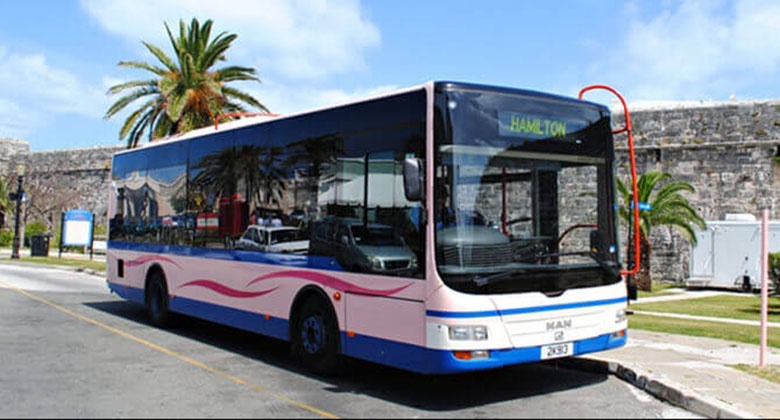
Pink Bermuda public bus near the coast

Travel Guide

Bermuda Shorelink bus and ferry pass guide

Use this guide to choose between cash, tokens, ticket booklets, the Shorelink app, and multi-day transportation passes for Bermuda buses and ferries.

ByMomentBook EditorialPublishedUpdated

Use this guide to choose between cash, tokens, ticket booklets, the Shorelink app, and multi-day transportation passes for Bermuda buses and ferries. The right choice depends on whether your trip stays within three fare zones, crosses into a 14-zone destination, or needs an easy transfer.

For most visitors taking more than one ride in a day, a Shorelink digital fare or an all-zone pass is safer than cash. Cash still works, but official guidance says bus cash must be exact coins, drivers do not make change, and bills are not accepted.

What to know first

  • Shorelink is the unified official brand for Bermuda buses and ferries, with 11 bus routes and 4 ferry routes operating seven days a week including public holidays.
  • Adult cash fare is BMD/USD 3.50 for up to 3 zones and BMD/USD 5.00 for 14 zones; children age 5-15 pay 2.75 and children under 5 ride free.
  • Transportation passes cover unlimited all-zone bus and ferry travel for consecutive 1, 2, 3, 4, or 7 day periods: adults 19.00, 31.50, 44.00, 48.50, or 62.00; children 9.50, 16.00, 22.00, 24.50, or 31.00.
  • Dockyard, St. George’s, L.F. Wade International Airport, Crystal Caves, Mangrove Bay, and Grotto Bay are listed as 14-zone visitor destinations.
  • Horseshoe Bay, Elbow Beach, Gibbs Hill Lighthouse, Botanical Gardens, and the Aquarium are listed as 3-zone visitor destinations.
  • Paper bus transfers are for continuous journeys and normally connect to the next scheduled bus; ferry acceptance is limited to Hamilton to St. George’s via Dockyard.
  • Bermuda buses are not fully accessible: they can kneel and some carry folded wheelchairs, but official guidance says buses do not have ramps.
Pink Bermuda public bus near the coast

Source: Government of Bermuda Department of Public Transportation.

Choose the fare before boarding

Use cash only for a simple ride when you already have exact coins. Choose tokens, ticket booklets, or Shorelink when you want to avoid change at the stop. Choose a pass when a day mixes bus and ferry or when plans may expand after a beach stop.

Plan by zones and routes

Bermuda is compact, but the official fare system is zonal. Route 7 and Route 8 are practical for Somerset and Dockyard. Routes 1, 3, 10, and 11 serve St. George’s and east-end sights; Route 6 links St. George’s and St. David’s.

Build the day around Hamilton

Hamilton is the easiest planning anchor because it has the Central Bus Terminal and the main Ferry Terminal. Ferry routes should be treated as schedule-based services, especially on holidays, in weather disruption, and on cruise-ship days.

Rules that affect transfers

Transfers are not sightseeing stopovers. Official guidance describes a continuous bus journey and a 15-minute transfer window unless the service interval is longer. Paper ferry transfer acceptance is limited to Hamilton to St. George’s via Dockyard.

Common mistakes

Do not buy a 3-zone fare for airport, Dockyard, St. George’s, Crystal Caves, Mangrove Bay, or Grotto Bay. Do not assume every sales point sells every product. Do not rely on bus ramps because buses do not have them.

Who should choose each option

Choose cash for one clear ride, Shorelink for digital purchase and app transfer validation, a 1- or 2-day pass for a beach plus Hamilton plus ferry day, and a longer pass when public transport is your main trip transport.

What to check before you go

Recheck Shorelink schedules, fare sale locations, service alerts, weather, and accessibility before leaving. If accessibility matters, confirm the exact vehicle, stop, ferry terminal, and route.

Final planning checks

Use this guide as a decision sequence, not as a promise that every counter, gate, platform, trail, or desk will behave the same way on the day you arrive. Start with the official source links, then compare them with your real date, arrival time, group size, mobility needs, luggage, and payment method. If the official page has changed since the checked date, follow the current official page and keep this article as the structure for the questions you still need to answer.

For Bermuda Shorelink bus and ferry pass guide, the most useful habit is to keep the practical pieces together. Put tickets, booking references, QR codes, identity documents, pass numbers, screenshots, and the relevant official page in one place before leaving your hotel. If a staff member, driver, guide, ticket desk, or gate agent asks for proof, you should not have to search through email, browser tabs, and photo albums while a queue forms behind you.

Build a time buffer around the strictest point in the plan. That may be last entry, the last return trip, a timed reservation, a maintenance window, a ferry or train connection, a security check, or the moment when weather makes the experience less useful. The buffer is especially important when the route has more than one operator, when a holiday schedule is possible, or when the plan depends on a transfer that is easy on a map but slow in real life.

Treat prices and rules as items to verify, not as trivia to memorize. A good travel plan notes the current fare, permit, pass, age rule, discount category, closure day, bag policy, photo rule, and accessibility limit, then checks the official page again before payment. This avoids the common mistake of buying the right product for last season and the wrong product for this visit.

If the visit matters a lot, prepare a fallback that uses the same area instead of rebuilding the whole day from zero. Choose a nearby indoor stop for bad weather, a lighter route for tired companions, a later meal option for a queue delay, and a return plan that still works if the first choice sells out or stops early. The fallback should be simple enough to use without research under pressure.

Finally, read the source section with a practical lens. Official pages answer different questions: one may confirm the price, another the route, another closures, and another visitor rules. Check the page that matches the decision you are about to make, and do not assume that one source covers every operational detail. That habit keeps the article stable while still letting the newest official information control the final choice.

How to use the sections

Use "What to know first" as a checkpoint, not just as background reading. Confirm what decision it supports, what proof or timing it requires, and what you will do if the official source gives a different answer on the travel day.

Use "Choose the fare before boarding" as a checkpoint, not just as background reading. Confirm what decision it supports, what proof or timing it requires, and what you will do if the official source gives a different answer on the travel day.

Use "Plan by zones and routes" as a checkpoint, not just as background reading. Confirm what decision it supports, what proof or timing it requires, and what you will do if the official source gives a different answer on the travel day.

Use "Build the day around Hamilton" as a checkpoint, not just as background reading. Confirm what decision it supports, what proof or timing it requires, and what you will do if the official source gives a different answer on the travel day.

Use "Rules that affect transfers" as a checkpoint, not just as background reading. Confirm what decision it supports, what proof or timing it requires, and what you will do if the official source gives a different answer on the travel day.

Use "Common mistakes" as a checkpoint, not just as background reading. Confirm what decision it supports, what proof or timing it requires, and what you will do if the official source gives a different answer on the travel day.

Use "Who should choose each option" as a checkpoint, not just as background reading. Confirm what decision it supports, what proof or timing it requires, and what you will do if the official source gives a different answer on the travel day.

Use "What to check before you go" as a checkpoint, not just as background reading. Confirm what decision it supports, what proof or timing it requires, and what you will do if the official source gives a different answer on the travel day.

Sources

Checked date: 2026-05-11