Madagascar Andasibe-Mantadia ticket, guide, and trail choice guide
Andasibe is often sold as a simple rainforest stop from Antananarivo, but the useful decision is more precise: choose the easier Analamazaotra side, the deeper Mantadia side, or
ByMomentBook Editorial·Published
Andasibe is often sold as a simple rainforest stop from Antananarivo, but the useful decision is more precise: choose the easier Analamazaotra side, the deeper Mantadia side, or a two-part stay that gives both areas enough time.
This guide is for travelers who want lemurs, forest trails, and official park logistics without turning the visit into a vague nature tour. The main constraint is that tickets, local guiding, vehicle access, rain, and trail difficulty matter more than the short-looking distance on the map.
What to know first
Madagascar National Parks places Mantadia 140 km from Antananarivo and 250 km from Tamatave, reached by RN2 through Moramanga and Andasibe.
The official Mantadia page says park access requires a field car, so do not treat the whole area as a normal paved-road stop.
The visitor centre at Mantadia gives information on prices, tours, timetables, and arrangements with local guides.
The official conduct rules say animals may not be touched, visitors should carry a ticket on every visit, and guiding with local guides is compulsory.
Mantadia circuits listed by the park include Rianasoa, easy, 2 hours; Chute Sacree, easy, 2 hours; and Tsakoka, difficult with steep slopes, 3 hours.
May to October is the dry-season period recommended for wildlife conditions; November to April is greener and rainier, with birdwatching interest but more weather risk.
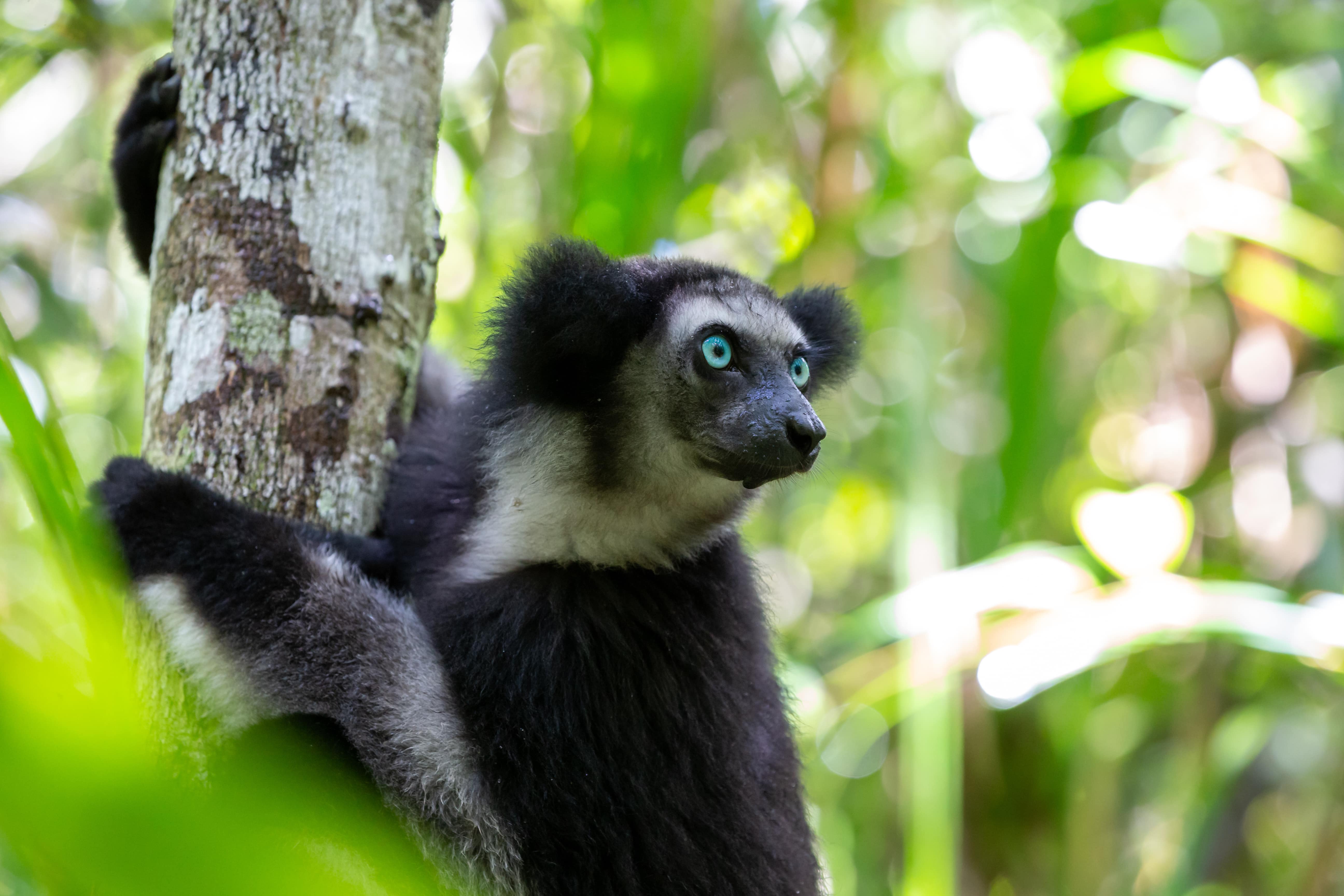
Mantadia forest indri lemur resting among green leaves
Source: Madagascar National Parks Mantadia official image.
Choose Analamazaotra, Mantadia, or both
If you have only one practical park session, start by considering Analamazaotra. Madagascar National Parks describes Analamazaotra as 140 km east of Antananarivo, beside RN2, and covering 874 hectares between roughly 900 and 1,050 metres in altitude. It is the easier side to combine with a short Andasibe stay, especially if your priority is hearing or seeing Indri indri without adding a rougher vehicle approach.
Mantadia is the better choice when the forest itself is the reason for the trip. The official page gives a much larger protected area of 15,480 hectares and lists 14 lemur species, 108 bird species, 51 reptile species, and 84 amphibian species. That larger scope is attractive for naturalists, birders, and travelers who want more than a quick indri stop.
Trying to do both areas in a single rushed day is usually the weak plan. A stronger plan is to sleep near Andasibe, use one session for the accessible Analamazaotra side, and reserve another session for Mantadia if you have the vehicle, guide, and weather window. That gives you room for rain, road delay, and the reality that wildlife watching is not scheduled like a museum entry.
Plan the RN2 access and vehicle choice
The official Mantadia directions make the route sound straightforward: follow RN2 between Antananarivo and Tamatave, continue from Moramanga to Andasibe, then reach the park reception. The decision point is not the road name. It is whether your vehicle can reach the reception and trail start comfortably on the day you go.
For Analamazaotra-focused trips, staying in or near Andasibe village reduces friction. For Mantadia, treat the vehicle as part of the ticket decision. The English official page says access requires a field car, so confirm a suitable vehicle in advance and ask whether the driver knows the park reception, not only the village.
Travelers using shared transport should separate the long-distance transfer from the park access problem. Reaching Andasibe by road is not the same as reaching a Mantadia circuit on time. Ask your lodge, guide, or driver exactly where they will pick you up, how long the last section normally takes after rain, and whether the return vehicle waits during the hike.
Buy the ticket and arrange the guide
Madagascar National Parks says the Mantadia visitor centre provides information on prices, tours, timetables, and arrangements with local guides. Use that as the authority for the visit day. A price copied from an old blog or a tour quote is useful only after it matches the current official desk or document.
The three official conduct points that change the visit are clear. Do not touch animals. Carry a ticket for each visit. Go with a local guide. These are not decorative rules; they control visitor movement, protect wildlife, and help the park manage people across different trails.
Ask for the cost as separate items before paying. Entry, guiding, vehicle access, lodging pick-up, professional image rights, research permissions, and optional community or tree-planting activities may not be one bundled price. Madagascar National Parks publishes a fee reference image, but this guide deliberately avoids freezing an amount because the exact payable category should be rechecked on the official source or at the visitor centre.
Pick a circuit by time and fitness
Mantadia gives you a useful official decision table. Rianasoa is listed as an easy 2-hour circuit with a natural pool, streams, insects, and birds. Chute Sacree is also listed as easy and 2 hours. Those are the safer choices for families, rainy days, late starts, or travelers who want a forest experience without committing the whole day.
Tsakoka is different. The official listing connects it with lemurs, endemic birds, and amphibians, but also marks it as difficult with steep slopes and a 3-hour duration. Do not place it after a long road transfer unless you have footwear, water, rain protection, and a driver or lodge transfer that can absorb delays.
Analamazaotra adds another layer. Its official page mentions quality ecotourism circuits such as INDRI 1, INDRI 2, AVENTURE, and ANIVOKELY. If indri is the main reason for the trip, ask the guide which circuit is sensible for that morning rather than forcing a fixed route from home. Forest sound, recent sightings, rain, and trail maintenance can all matter.
Time the visit around season, rain, and wildlife
The official Mantadia page says the park can be visited year-round and identifies May to October as the dry season with good wildlife observation conditions. Dry season does not mean dry trail. Carry a waterproof layer, shoes with grip, and a plan for protecting cameras and documents.
November to April is described as greener and interesting for birdwatching, but with more frequent rain. In that period, a short morning circuit plus a flexible afternoon is usually stronger than a long fixed hike. It also reduces the chance that one shower ruins the only activity you planned.
Wildlife timing should be discussed with the guide on the day before or the morning of the visit. Indri calls, bird activity, and amphibian interest are tied to conditions. No official source promises a guaranteed sighting, so frame your plan around the best available circuit and a good guide, not around a species checklist that must be completed.
Rules and exceptions that change the visit
The no-touching rule includes the moments when a photograph feels tempting. Do not block an animal, feed it, call it closer, or step away from the guide to improve an angle. In a small forest encounter, visitor behaviour is part of conservation.
The ticket rule also deserves attention. If you split the day into a morning circuit, an afternoon circuit, or a transfer between reception points, keep the ticket or receipt available. Ask whether a phone photo is enough or whether a paper proof is expected.
The Madagascar Ministry of Tourism reported that the One Tourist, One Tree initiative launched at Mantadia on 4 December 2025. The project lets visitors plant a tree and follow it through a QR code. Treat it as an optional programme to ask about, not as a guaranteed inclusion in every park visit.
Common mistakes
The first mistake is treating Andasibe as one entrance. Analamazaotra and Mantadia are close in traveler language, but not identical in logistics. Vehicle need, circuit length, and timing can change sharply between them.
The second mistake is planning only from a fee number. The practical cost is the combination of entry, guide, vehicle, possible pick-up, and any special image or research permission. Write the included items down before you hand over payment.
The third mistake is placing a difficult trail after a late road arrival. Rainforest trails can become slow even when the official duration is short. Put harder circuits earlier in the day and keep the return transfer realistic.
The fourth mistake is assuming a guide is optional because the trail looks clear. The official conduct rule says local guiding is compulsory. Use that guide actively: ask about the best circuit for the day, how far to stand from animals, and when to switch plans.
Who should choose which option
Choose Analamazaotra if you want the most efficient Andasibe experience, have limited time, or are traveling with people who would rather avoid rougher access. It fits visitors who want a structured forest walk and a practical chance to focus on indri.
Choose Mantadia if your priority is deeper forest, birdlife, amphibians, and more demanding trail choices. It suits travelers who can arrange the field car, accept muddy conditions, and build the day around the park instead of treating it as a roadside stop.
Choose both only if the itinerary gives you a night near Andasibe or a very early start with a reliable vehicle. The value of two areas comes from contrast, not from rushing between them. Give the guide enough time to choose routes based on the day’s conditions.
What to check before you go
Current entry fee, guide fee, payment method, and whether any fee category changed.
The exact reception point for your chosen circuit and the vehicle needed to reach it.
Whether Rianasoa, Chute Sacree, Tsakoka, or the Analamazaotra circuit you want is operating that day.